- The 64
- Hexagram 52
52 艮 Stillness
艮 Mountain below, 艮 Mountain above
Mountain over mountain: stillness, keeping still. The text says to hold still at the back, so that the self is not noticed; to walk in the courtyard and not see the people there; no blame.
Tap a line of the figure to see where it leads when it changes. Cast for a question of your own. New here? What the I Ching is, coming from tarot.
This site's reading
卦辭 艮其背,不獲其身,行其庭,不見其人,无咎: still the back, and the body is not grasped; walk in the courtyard and not see the person; no blame. Stillness so complete that even one's own self and the people around drop out of attention.
彖 The commentary: 艮 is stopping. When it is time to stop, stop; when it is time to go, go; movement and rest each in their time, and the way is bright. Stopping in its place. Above and below oppose and do not join, hence not grasping the self and not seeing the people.
大象 Mountains joined: the noble person's thoughts do not go beyond his position (思不出其位). Stillness of the mind is staying inside what is yours.
爻 The lines move up the body: stilling the toes, no blame, lasting firmness advantageous; stilling the calves, unable to save the one followed, the heart not glad; stilling the loins, splitting the back, danger, the heart suffocated; stilling the trunk, no blame; stilling the jaws, words in order, regret gone; and at the top generous stillness, good. Stillness forced at the waist (line 3) hurts; stillness that reaches the whole body (line 4) and the words (line 5) is the counsel.
If your question is about
- A relationship
- Keep still so completely that you stop watching yourself (the Judgment); words in order (line 5) rather than many. Forced stillness (line 3) hurts.
- Work
- Stop when it is time to stop (the commentary); keep your thoughts within your post (the Image). Rest is a skill here.
- A decision
- Not now; this is the hexagram of holding still. When the time to go comes, the same text says go.
- No line changing
- Stillness that stays. Generous stillness (line 6) is the good end: calm without strain, inside your own position.
Written from the text above and checked against it by Lun (2026-10-24). It is a way of reading the hexagram, not a prediction.
The text, with Legge
Judgment 卦辭
艮:艮其背,不獲其身,行其庭,不見其人,无咎。
When one’s resting is like that of the back, and he loses all consciousness of self; when he walks in his courtyard, and does not see any (of the persons) in it,—there will be no error. (Legge, 1882)
Commentary on the Judgment 彖
艮,止也。時止則止,時行則行,動靜不失其時,其道光明。艮其止,止其所也。上下敵應,不相與也。是以不獲其身,行其庭不見其人,无咎也。
The Image 大象
兼山,艮;君子以思不出其位。
The six lines
Line 1 初六
艮其趾,无咎,利永貞。
The first line, divided, shows its subject keeping his toes at rest. There will be no error; but it will be advantageous for him to be persistently firm and correct. (Legge, 1882)
The Image 小象
艮其趾,未失正也。
Changing, this line leads to 22 賁 Bì.
Line 2 六二
艮其腓,不拯其隨,其心不快。
The second line, divided, shows its subject keeping the calves of his legs at rest. He cannot help (the subject of the line above) whom he follows, and is dissatisfied in his mind. (Legge, 1882)
The Image 小象
不拯其隨,未退聽也。
Changing, this line leads to 18 蠱 Gǔ.
Line 3 九三
艮其限,裂其夤,厲閽心。
The third line, undivided, shows its subject keeping his loins at rest, and separating the ribs (from the body below). The situation is perilous, and the heart glows with suppressed excitement. (Legge, 1882)
The Image 小象
艮其限,危薰心也。
Changing, this line leads to 23 剝 Bō.
Line 4 六四
艮其身,无咎。
The fourth line, divided, shows its subject keeping his trunk at rest. There will be no error. (Legge, 1882)
The Image 小象
艮其身,止諸躬也。
Changing, this line leads to 56 旅 Lǚ.
Line 5 六五
艮其輔,言有孚,悔亡。
The fifth line, divided, shows its subject keeping his jawbones at rest, so that his words are (all) orderly. Occasion for repentance will disappear. (Legge, 1882)
The Image 小象
艮其輔,以中正也。
Changing, this line leads to 53 漸 Jiàn.
Line 6 上九
敦艮,吉。
The sixth line, undivided, shows its subject devotedly maintaining his restfulness. There will be good fortune. (Legge, 1882)
The Image 小象
敦艮之吉,以厚終也。
Changing, this line leads to 15 謙 Qiān.
In history
The 左傳 and 國語, the chronicles of the sixth to fifth centuries BC, record real casts of the Changes and what came of them. One of them gave this hexagram.
575 BC: 穆姜, dowager of 魯, on being confined to the eastern palace
Asked: Will I get out of here? The stalks gave 52 艮 turning to 17 隨.
是謂艮之隨.隨其出也.君必速出.The scribe read 艮之八 as 艮 turning into 隨, and 隨 means following, going out: she would soon be released. 穆姜 refused the comfort. 隨 promises 元亨利貞 without fault only to someone with those four virtues; a woman who had joined a plot, harmed the state and left her place had none, so she would die there.
She stayed in the eastern palace and died there, in 564 BC, as she had said.
左傳 襄公九年, 維基文庫 (revision 9172568). 艮之八 is the old notation: 艮 with five lines changing and only the second, a yin line (八), unmoved, which the scribe resolves as 隨. No single moving line can be given. The year is that of her confinement after the 僑如 plot of 成公十六年; the 左傳 tells the story under the year of her death. This page's text omits 無 in 無咎 twice; the received 隨 judgment reads 元亨利貞,无咎.
The chronicles' diviners read from oracle texts of their own time; where their words match our clause text the note says so, and where they do not, it says that. None of this is a claim that the text foretold the event.
Related hexagrams
Where the name comes from
艮
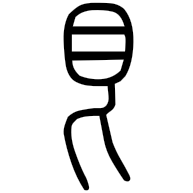 篆文 seal
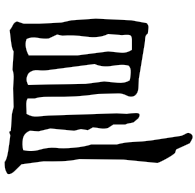 隸書 clerical · 東漢
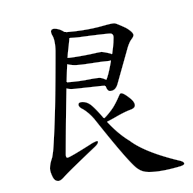 楷書 regular
Legge's note (1882)
Legge's title for the hexagram: a mountain; resting.
LII. The trigram Kăn represents a mountain. Mountains rise up grandly from the surface of the earth, and their masses rest on it in quiet and solemn majesty; and they serve also to arrest the onward progress of the traveller. Hence the attribute ascribed to Kăn is twofold; it is both active and passive—resting and arresting. The character is used in this hexagram with both of those significations. As the name of the figure, it denotes the mental characteristic of resting in what is right; especially resting, as it is expressed by Chinese critics, ‘in principle,’—that which is right, on the widest scale, and in the absolute conception of the mind; and that which is right in every different position in which a man can be placed. We find this treated of in the Great Learning (Commentary, chapter 3), and in the Doctrine of the Mean, chapter 14, and other places. This is the theme of the hexagram; and the symbolism of it is all taken from different parts of the human body, as in hexagram 31, and the way in which they are dealt with. Several of the paragraphs are certainly not easy to translate and interpret. The other parts of the body, such as the mouth, eyes, and ears, have their appetencies, which lead them to what is without themselves. The back alone has nothing to do with anything beyond itself—hardly with itself even; all that it has to do is to stand straight and strong. So should it be with us, resting in principle, free from the intrusion of selfish thoughts and external objects. Amidst society, he who realises the idea of the hexagram is still alone, and does not allow himself to be distracted from the contemplation and following of principle. He is not a recluse, however, who keeps aloof from social life; but his distinction is that he maintains a supreme regard to principle, when alone, and when mingling with others. In the symbolism the author rises from one part of the body to the other. The first line at the bottom of the figure fitly suggests ‘the toes.’ The lesson is that from the first men should rest in, and be anxious to do, what is right in all their affairs. The weakness of the line and its being in an odd place give occasion for the caution, with which the paragraph concludes. Above the toes are the calves, represented by the second line, weak, but in its proper place. Above this, again, are the loins, represented by 3, strong, and in danger of being violent. Line 2 follows 3, and should help it; but is unable to do so; and there results dissatisfaction. When the calves are kept at rest, advance is stopped, but no other harm ensues. Not so when the loins are kept at rest, and unable to bend, for the connexion between the upper and lower parts of the body is then broken. The dissatisfaction increases to an angry heat. Paragraph 3 is unusually difficult. For ‘loins’ P. Regis has scapulae, and for ribs renes; Canon McClatchie says:—‘Third Nine is stopping at a limit, and separating what is in continued succession (i.e. the backbone); thus the mind,’ &c. Line 4 is a weak line resting in a proper place; hence it gives a good auspice. The Khang-hsî editors, however, call attention to the resting of the trunk as being inferior to the resting of the back in the Thwan. The place of the weak fifth line is not proper for it; and this accounts for the mention of its subject ‘repenting,’ for which, however, there is not occasion. The third line of the trigrams, and the sixth of the hexagram, is what makes Kăn what it is—the symbol of a mountain. The subject of it therefore will carry out the resting required by the whole figure in the highest style.
Sources
- Chinese text: 周易, 維基文庫, page (revision 10647135); the text is public domain, the site's edits CC BY-SA 4.0.
- English: James Legge, The Yî King, Sacred Books of the East vol. XVI, Oxford 1882 (public domain), where this hexagram is “Kăn”.
- Glyph images: 小學堂 字形演變, Academia Sinica (CC0 1.0).
- Pinyin: Unihan (Unicode License v3) with this site's readings for the classical cases. English gloss, relations, the idiom glosses, the English of the chronicle passages and the plain reading: this site.