- The 64
- Hexagram 23
23 剝 Stripping Away
坤 Earth below, 艮 Mountain above
One strong line left at the top over five yielding ones: stripping away, the bed eaten from below. The text says it is not advantageous to go anywhere; the lines show how far the stripping has reached.
Tap a line of the figure to see where it leads when it changes. Cast for a question of your own. New here? What the I Ching is, coming from tarot.
This site's reading
卦辭 剝:不利有攸往. Stripping; not advantageous to have somewhere to go. The hexagram is the yielding changing the firm until one line is left.
彖 The commentary: stripping is the yielding changing the firm; not advantageous to go, because the small men are growing. Accord with it and stop, viewing the image; the noble person honours waning and waxing, fullness and emptiness, the way of heaven.
大象 The mountain rests on the earth: those above make the base thick and the dwelling secure. When the top is being stripped, strengthen what is under it.
爻 The lines: stripping the bed at the legs, firmness destroyed, evil; stripping the bed at the frame, firmness destroyed, evil; stripping, and no blame, the one line that has let go; stripping the bed to the skin, evil; a string of fish, favour through the palace women, nothing not advantageous; and at the top the great fruit uneaten, the noble person gets a carriage, the small man strips his own hut. The last line is the seed that survives the stripping.
If your question is about
- A relationship
- Something is being eaten away from below and the text says do not act on it; accord and stop, says the commentary. The fruit survives.
- Work
- Not the time to move; small men are growing. Thicken the base (the Image), secure the dwelling, keep the seed uneaten.
- A decision
- No. Not advantageous to go anywhere; the stripping has to run. Line 3's no blame is for the one who steps aside from it.
- No line changing
- Stripping as a state: the bed keeps being eaten. Hold the top line; the fruit is kept for the turn, which is the next hexagram.
Written from the text above and checked against it by Lun (2026-10-24). It is a way of reading the hexagram, not a prediction.
The text, with Legge
Judgment 卦辭
剝:不利。有攸往。
Po indicates that (in the state which it symbolises) it will not be advantageous to make a movement in any direction whatever. (Legge, 1882)
Commentary on the Judgment 彖
剝,剝也,柔變剛也。不利有攸往,小人長也。順而止之,觀象也。君子尚消息盈虛,天行也。
The Image 大象
山附地上,剝;上以厚下,安宅。
The six lines
Line 1 初六
剝牀以足,蔑貞凶。
The first line, divided, shows one overturning the couch by injuring its legs. (The injury will go on to) the destruction of (all) firm correctness, and there will be evil. (Legge, 1882)
The Image 小象
剝牀以足,以滅下也。
Changing, this line leads to 27 頤 Yí.
Line 2 六二
剝牀以辨,蔑貞凶。
The second line, divided, shows one overthrowing the couch by injuring its frame. (The injury will go on to) the destruction of (all) firm correctness, and there will be evil. (Legge, 1882)
The Image 小象
剝牀以辨,未有與也。
Changing, this line leads to 4 蒙 Méng.
Line 3 六三
剝之,无咎。
The third line, divided, shows its subject among the overthrowers; but there will be no error. (Legge, 1882)
The Image 小象
剝之无咎,失上下也。
Changing, this line leads to 52 艮 Gèn.
Line 4 六四
剝牀以膚,凶。
The fourth line, divided, shows its subject having overthrown the couch, and (going to injure) the skin (of him who lies on it). There will be evil. (Legge, 1882)
The Image 小象
剝牀以膚,切近災也。
Changing, this line leads to 35 晉 Jìn.
Line 5 六五
貫魚,以宮人寵,无不利。
The fifth line, divided, shows (its subject leading on the others like) a string of fishes, and (obtaining for them) the favour that lights on the inmates of the palace. There will be advantage in every way. (Legge, 1882)
The Image 小象
以宮人寵,終无尤也。
Changing, this line leads to 20 觀 Guān.
Line 6 上九
碩果不食,君子德車,小人剝廬。
The topmost line, undivided, shows its subject (as) a great fruit which has not been eaten. The superior man finds (the people again) as a chariot carrying him. The small men (by their course) overthrow their own dwellings. (Legge, 1882)
The Image 小象
君子得輿,民所載也。小人剝廬,終不可用也。
Changing, this line leads to 2 坤 Kūn.
Words that came from it
Phrases a billion people use today began as clauses of this hexagram.
- 消息
- waning and waxing, emptying and filling. The ordinary word for news is the commentary's pair of words for decline and growth. From the commentary on the Judgment 彖: 消息盈虛.
- 碩果僅存
- the one great fruit left uneaten. The last survivor of a kind; the idiom grew from this line's single fruit at the top of the stripped tree. From line 6: 碩果不食.
In the calendar
In the Han dynasty's 卦氣 tradition, which lays the hexagrams over the year, 剝 is one of the twelve sovereign hexagrams 消息卦: it governs the month that begins at 霜降, frost's descent, and runs until 小雪 (light snow), the ninth month of the traditional year, the month of 戌. Five yin lines; one yang left at the top, the last fruit on the tree.
The calendar is a later tradition about the hexagrams, not part of the text above.
Related hexagrams
Where the name comes from
剝
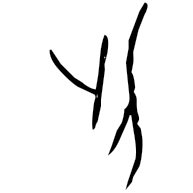 甲骨文 oracle bone · 商
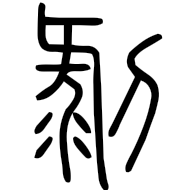 篆文 seal
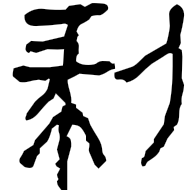 隸書 clerical · 秦
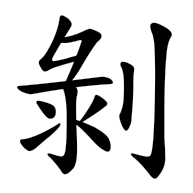 楷書 regular
Legge's note (1882)
Legge's title for the hexagram: falling, overthrow.
XXIII. Po is the symbol of falling or of causing to fall, and may be applied, both in the natural and political world, to the process of decay, or that of overthrow. The figure consists of five divided lines, and one undivided, which last thus becomes the prominent and principal line in the figure. Decay or overthrow has begun at the bottom of it, and crept up to the top. The hexagram is that of the ninth month, when the beauty and glory of summer have disappeared, and the year is ready to fall into the arms of sterile winter. In the political world, small men have gradually displaced good men and great, till but one remains; and the lesson for him is to wait. The power operating against him is too strong; but the fashion of political life passes away. If he wait, a change for the better will shortly appear. The lesser symbolism is chiefly that of a bed or couch with its occupant. The idea of the hexagram requires this occupant to be overthrown, or at least that an attempt be made to overthrow him. Accordingly the attempt in line 1 is made by commencing with the legs of the couch. The symbolism goes on to explain itself. The object of the evil worker is the overthrow of all firm correctness. Of course there will be evil. Line 2 is to the same effect as 1; only the foe has advanced from the legs to the frame of the couch. Line 3 also represents an overthrower; but it differs from the others in being the correlate of 6. The subject of it will take part with him. His association is with the subject of 6, and not, as in the other weak lines, with one of its own kind. From line 4 the danger is imminent. The couch has been overthrown. The person of the occupant is at the mercy of the destroyers. With line 5 the symbolism changes. The subject of 5 is ‘lord of all the other weak lines,’ and their subjects are at his disposal. He and they are represented as fishes, following one another as if strung together. All fishes come under the category of yin. Then the symbolism changes again. The subject of 5, representing and controlling all the yin lines, is loyal to the subject of the yang sixth line. He is the rightful sovereign in his palace, and 5 leads all the others there to enjoy the sovereign’s favours. We have still different symbolism under line 6. Its strong subject, notwithstanding the attempts against him, survives, and acquires fresh vigour. The people again cherish their sovereign, and the plotters have wrought to their own overthrow.
Sources
- Chinese text: 周易, 維基文庫, page (revision 10645800); the text is public domain, the site's edits CC BY-SA 4.0.
- English: James Legge, The Yî King, Sacred Books of the East vol. XVI, Oxford 1882 (public domain), where this hexagram is “Po”.
- Glyph images: 小學堂 字形演變, Academia Sinica (CC0 1.0).
- Pinyin: Unihan (Unicode License v3) with this site's readings for the classical cases. English gloss, relations, the idiom glosses, the English of the chronicle passages and the plain reading: this site.