- The 64
- Hexagram 40
40 解 Release
坎 Water below, 震 Thunder above
Thunder and rain breaking the tension: release, the knot untied. The text says the south-west is advantageous, that returning is good when there is nowhere to go, and that if there is somewhere to go, early is good.
Tap a line of the figure to see where it leads when it changes. Cast for a question of your own. New here? What the I Ching is, coming from tarot.
This site's reading
卦辭 利西南,无所往,其來復吉。有攸往,夙吉: the south-west is advantageous; with nowhere to go, coming back is good; with somewhere to go, early is good. Release is quick or it is not release.
彖 The commentary: danger, and movement that escapes the danger, is release. The south-west gains the many; coming back gains the centre; going early achieves. Heaven and earth release and thunder and rain come; thunder and rain come and every fruit and plant bursts its casing. "Great is the meaning of release's time."
大象 Thunder and rain: the noble person pardons errors and forgives offences. Release is also letting others go.
爻 The lines: no blame; hunting, three foxes taken and the yellow arrow found, firm and good; a porter riding in a carriage draws the robbers, firm and mean; release your big toe, and friends come with trust; the noble person alone has release, good, and the small men see his sincerity; and at the top a prince shoots a hawk on the high wall and takes it, nothing not advantageous. The third line is the one who keeps what release should have dropped.
If your question is about
- A relationship
- The knot comes undone; pardon and forgive (the Image), release what you hold (line 4), and friends come. Drop the burden (line 3).
- Work
- Resolve it early (the Judgment) or come back to centre; the hawk on the wall (line 6) is the one clean shot to take.
- A decision
- Act early if there is somewhere to go; otherwise return. Release is a quick motion, not a long campaign.
- No line changing
- Release as a state: the rain keeps falling and the casings keep bursting. Keep pardoning; keep nothing on your back.
Written from the text above and checked against it by Lun (2026-10-24). It is a way of reading the hexagram, not a prediction.
The text, with Legge
Judgment 卦辭
解:利西南,无所往,其來復吉。有攸往,夙吉。
In (the state indicated by) Kieh advantage will be found in the south-west. If no (further) operations be called for, there will be good fortune in coming back (to the old conditions). If some operations be called for, there will be good fortune in the early conducting of them. (Legge, 1882)
Commentary on the Judgment 彖
解,險以動,動而免乎險,解。解利西南,往得眾也。其來復吉,乃得中也。有攸往夙吉,往有功也。天地解,而雷雨作,雷雨作,而百果草木皆甲坼,解之時義大矣哉!
The Image 大象
雷雨作,解;君子以赦過宥罪。
The six lines
Line 1 初六
无咎。
The first line, divided, shows that its subject will commit no error. (Legge, 1882)
The Image 小象
剛柔之際,義无咎也。
Changing, this line leads to 54 歸妹 Guī Mèi.
Line 2 九二
田獲三狐,得黃矢,貞吉。
The second line, undivided, shows its subject catch, in hunting, three foxes, and obtain the yellow (= golden) arrows. With firm correctness there will be good fortune. (Legge, 1882)
The Image 小象
九二貞吉,得中道也。
Changing, this line leads to 16 豫 Yù.
Line 3 六三
負且乘,致寇至,貞吝。
The third line, divided, shows a porter with his burden, (yet) riding in a carriage. He will (only) tempt robbers to attack him. However firm and correct he may (try to) be, there will be cause for regret. (Legge, 1882)
The Image 小象
負且乘,亦可丑也,自我致戎,又誰咎也。
Changing, this line leads to 32 恒 Héng.
Line 4 九四
解而拇,朋至斯孚。
(To the subject of) the fourth line, undivided, (it is said), ‘Remove your toes. Friends will (then) come, between you and whom there will be mutual confidence.’ (Legge, 1882)
The Image 小象
解而拇,未當位也。
Changing, this line leads to 7 師 Shī.
Line 5 六五
君子惟有解,吉;有孚于小人。
The fifth line, divided, shows (its subject), the superior man (=the ruler), executing his function of removing (whatever is injurious to the idea of the hexagram), in which case there will be good fortune, and confidence in him will be shown even by the small men. (Legge, 1882)
The Image 小象
君子有解,小人退也。
Changing, this line leads to 47 困 Kùn.
Line 6 上六
公用射隼,于高墉之上,獲之,无不利。
In the sixth line, divided, we see a feudal prince (with his bow) shooting at a falcon on the top of a high wall, and hitting it. (The effect of his action) will be in every way advantageous. (Legge, 1882)
The Image 小象
公用射隼,以解悖也。
Changing, this line leads to 64 未濟 Wèi Jì.
Related hexagrams
Where the name comes from
解
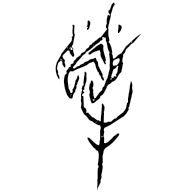 甲骨文 oracle bone · 商
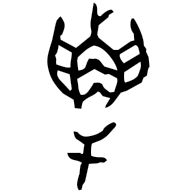 金文 bronze · 西周早期
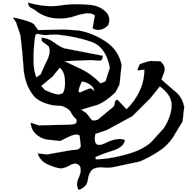 戰國文字 Warring States · 戰國.楚
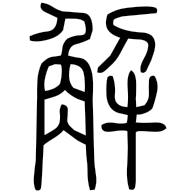 篆文 seal
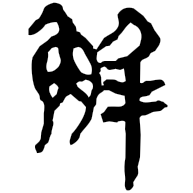 隸書 clerical · 秦
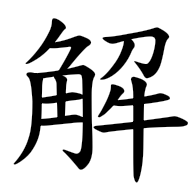 楷書 regular
Legge's note (1882)
Legge's title for the hexagram: loosing, untying.
XL. Kieh is the symbol of loosing,—untying a knot or unravelling a complication; and as the name of this hexagram, it denotes a condition in which the obstruction and difficulty indicated by the preceding Kien have been removed. The object of the author is to show, as if from the lines of the figure, how this new and better state of the kingdom is to be dealt with. See what is said on the Thwan of Kien for ‘the advantage to be found in the south-west.’ If further active operations be not necessary to complete the subjugation of the country, the sooner things fall into their old channels the better. The new masters of the kingdom should not be anxious to change all the old manners and ways. Let them do, as the duke of Kâu actually did do with the subjugated people of Shang. If further operations be necessary, let them be carried through without delay. Nothing is said in the Thwan about the discountenancing and removal of small men,—unworthy ministers or officers; but that subject appears in more than one of the lines. There is a weak line, instead of a strong, in the first place; but this is compensated for by its strong correlate in 4. Kû Hsî says he does not understand the symbolism under line 2. The place is even, but the line itself is strong; the strength therefore is modified or tempered. And 2 is the correlate of the ruler in 5. We are to look to its subject therefore for a minister striving to realise the idea of the hexagram, and pacify the subdued kingdom. He becomes a hunter, and disposes of unworthy men, represented by ‘the three foxes.’ He also gets the yellow arrows,— the instruments used in war or in hunting, whose colour is ‘correct,’ and whose form is ‘straight.’ His firm correctness will be good. Line 3 is weak, when it should be strong; and occupying, as it does, the topmost place of the lower trigram, it suggests the symbolism of a porter in a carriage. People will say, ‘How did he get there? The things cannot be his own.’ And robbers will attack and plunder him. The subject of the line cannot protect himself, nor accomplish anything good. What is said on the fourth line appears in the form of an address to its subject. The line is strong in an even place, and 1, its correlate, is weak in an odd place. Such a union will not be productive of good. In the symbolism 1 becomes the toe of the subject of 4. How the friend or friends, who are to come to him on the removal of this toe, are represented, I do not perceive. Line 5 is weak in an odd place; but the place is that of the ruler, to whom it belongs to perfect the idea of the hexagram by removing all that is contrary to the peace and good order of the kingdom. It will be his duty to remove especially all the small men represented by the divided lines, which he can do with the help of his strong correlate in 2. Then even the small men will change their ways, and repair to him. Line 6 is the highest line in the figure, but not the place of the ruler. Hence it appears as occupied by a feudal duke, who carries out the idea of the figure against small men, according to the symbolism employed.
Sources
- Chinese text: 周易, 維基文庫, page (revision 10646666); the text is public domain, the site's edits CC BY-SA 4.0.
- English: James Legge, The Yî King, Sacred Books of the East vol. XVI, Oxford 1882 (public domain), where this hexagram is “Kieh”.
- Glyph images: 小學堂 字形演變, Academia Sinica (CC0 1.0).
- Pinyin: Unihan (Unicode License v3) with this site's readings for the classical cases. English gloss, relations, the idiom glosses, the English of the chronicle passages and the plain reading: this site.