- The 64
- Hexagram 18
18 蠱 Decay
巽 Wind below, 艮 Mountain above
Wind caught under a mountain, going stale: decay, and the work of putting it right. The text says it gets through greatly and the great stream can be crossed; the lines are about mending what a parent left.
Tap a line of the figure to see where it leads when it changes. Cast for a question of your own. New here? What the I Ching is, coming from tarot.
This site's reading
卦辭 蠱 is the bowl with worms in it, what has gone bad through neglect. The Judgment: greatly penetrating; advantageous to cross the great stream; three days before the day 甲 and three days after, that is, prepare before the start and follow through after it.
彖 The commentary: the firm above and the yielding below, gentle and then stopping, that is decay; dealing with it, the world is set in order. Crossing the stream is going to the work. Three days before and after: an end and then a beginning, the way of heaven.
大象 Wind below the mountain: the noble person rouses the people and nourishes virtue (振民育德). Decay is met with stirring, not with blame.
爻 The lines: a son dealing with his father's decay, and if the son is able the father is without blame, danger and then good; dealing with the mother's decay, where firmness cannot be pressed; the father's decay again, small regret, no great blame; indulging the father's decay, and going on meets humiliation; the father's decay dealt with and praised; and at the top one who serves neither king nor lord and makes his own work high. The inherited mess is handled line by line, and the top line steps out of it altogether.
If your question is about
- A relationship
- Something left to go stale, often from the generation before. Mend it with care (line 1); indulging it (line 4) ends in humiliation.
- Work
- An inherited mess; the text says it can be put right and the stream crossed. Prepare three days before, follow through three days after.
- A decision
- Yes, as repair rather than a new start. Rouse what has gone stale; the top line's refusal to serve is also an honest choice.
- No line changing
- Decay as a standing condition: the bowl stays spoiled until someone works at it. Nourish and rouse; it does not clear itself.
Written from the text above and checked against it by Lun (2026-10-24). It is a way of reading the hexagram, not a prediction.
The text, with Legge
Judgment 卦辭
蠱:元亨。利涉大川。先甲三日,後甲三日。
Kû indicates great progress and success (to him who deals properly with the condition represented by it). There will be advantage in (efforts like that of) crossing the great stream. (He should weigh well, however, the events of) three days before the turning point, and those (to be done) three days after it. (Legge, 1882)
Commentary on the Judgment 彖
蠱,剛上而柔下,巽而止,蠱。蠱,元亨,而天下治也。利涉大川,往有事也。先甲三日,後甲三日,終則有始,天行也。
The Image 大象
山下有風,蠱;君子以振民育德。
The six lines
Line 1 初六
幹父之蠱,有子考,无咎,厲終吉。
The first line, divided, shows (a son) dealing with the troubles caused by his father. If he be an (able) son, the father will escape the blame of having erred. The position is perilous, but there will be good fortune in the end. (Legge, 1882)
The Image 小象
幹父之蠱,意承考也。
Changing, this line leads to 26 大畜 Dà Chù.
Line 2 九二
幹母之蠱,不可貞。
The second line, undivided, shows (a son) dealing with the troubles caused by his mother. He should not (carry) his firm correctness (to the utmost). (Legge, 1882)
The Image 小象
幹母之蠱,得中道也。
Changing, this line leads to 52 艮 Gèn.
Line 3 九三
幹父之蠱,小有悔,无大咎。
The third line, undivided, shows (a son) dealing with the troubles caused by his father. There may be some small occasion for repentance, but there will not be any great error. (Legge, 1882)
The Image 小象
幹父之蠱,終无咎也。
Changing, this line leads to 4 蒙 Méng.
Line 4 六四
裕父之蠱,往見吝。
The fourth line, divided, shows (a son) viewing indulgently the troubles caused by his father. If he go forward, he will find cause to regret it. (Legge, 1882)
The Image 小象
裕父之蠱,往未得也。
Changing, this line leads to 50 鼎 Dǐng.
Line 5 六五
幹父之蠱,用譽。
The fifth line, divided, shows (a son) dealing with the troubles caused by his father. He obtains the praise of using (the fit instrument for his work). (Legge, 1882)
The Image 小象
幹父用譽,承以德也。
Changing, this line leads to 57 巽 Xùn.
Line 6 上九
不事王侯,高尚其事。
The sixth line, undivided, shows us one who does not serve either king or feudal lord, but in a lofty spirit prefers (to attend to) his own affairs. (Legge, 1882)
The Image 小象
不事王侯,志可則也。
Changing, this line leads to 46 升 Shēng.
In history
The 左傳 and 國語, the chronicles of the sixth to fifth centuries BC, record real casts of the Changes and what came of them. One of them gave this hexagram.
645 BC: 秦穆公, through his diviner 卜徒父, on attacking 晉
Asked: Will the campaign against 晉 succeed? The stalks gave 18 蠱.
其卦遇《蠱》,曰:『千乘三去,三去之餘,獲其雄狐。』夫狐蠱,必其君也。卜徒父 called it greatly auspicious: cross the river and the lord's chariots will be broken. Pressed, he explained that after three routs the ruler of 晉 would be taken; the oracle spoke of a thousand chariots thrice driven off and the male fox caught, the fox being the ruler. 蠱 is wind under mountain: autumn wind strips the tree.
晉 was beaten three times and the armies met at 韓原, where 秦 captured 晉惠公 and carried him off. He was released later that year.
左傳 僖公十五年, 維基文庫 (revision 10199429). A single hexagram with no moving line. The oracle quoted (千乘三去) is not the received text of 蠱; the diviner reasons from the trigrams.
The chronicles' diviners read from oracle texts of their own time; where their words match our clause text the note says so, and where they do not, it says that. None of this is a claim that the text foretold the event.
Related hexagrams
Where the name comes from
蠱
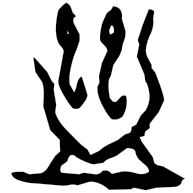 甲骨文 oracle bone · 商
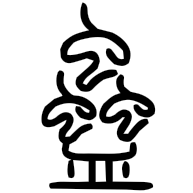 篆文 seal
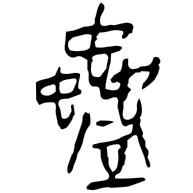 隸書 clerical · 秦
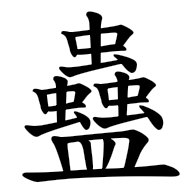 楷書 regular
Legge's note (1882)
Legge's title for the hexagram: troublesome services (arrest of decay).
XVIII. In the 6th Appendix it is said, ‘They who follow another are sure to have services (to perform), and hence Sui is followed by Kû.’ But Kû means the having painful or troublesome services to do. It denotes here a state in which things are going to ruin, as if through poison or venomous worms; and the figure is supposed to describe the arrest of the decay and the restoration to soundness and vigour, so as to justify its auspice of great progress and success. To realise such a result, however, great efforts will be required, as in crossing the great stream; and a careful consideration of the events that have brought on the state of decay, and the measures to be taken to remedy it is also necessary. See Appendix I on the ‘three days.’ The subject of line 1, and of all the other lines, excepting perhaps 6, appears as a son. Yet the line itself is of the yin nature, and the trigram in which it plays the principal part is also yin. Line 2 is strong, and of the yang nature, with the yin line 5 as its proper correlate. In line 2, 5 appears as the mother; but its subject there is again a son, and the upper trigram altogether is yang. I am unable to account for these things. As is said in the note of Regis on line 2:—‘Haec matris filiique denominatio ad has lineas mere translatitia est, et, ut ait commentarius vulgaris, ad explicationem sententiarum eas pro matre et filio supponere dicendum est. Nec ratio reddetur si quis in utroque hoc nomine mysterium quaerat. Cur enim aliis in figuris lineae nunc regem, nunc vasallum, jam imperii administrum, mox summum armorum praefectum referre dicantur? Accommodantur scilicet lineae ad verba sententiae et verba sententiae ad sensum, quemadmodum faciendum de methodis libri Shih King docet Mencius, V, i, ode 4. 2.’ We must leave this difficulty. Line 1 is weak, and its correlate 4 is also weak. What can its subject do to remedy the state of decay? But the line is the first of the figure, and the decay is not yet great. By giving heed to the cautions in the Text, he will accomplish what is promised. The ruler in line 5 is represented by a weak line, while 2 is strong. Thus the symbolism takes the form of a son dealing with the prevailing decay induced somehow by his mother. But a son must be very gentle in all his intercourse with his mother, and especially so, when constrained by a sense of duty to oppose her course. I do not think there is anything more or better to be said here. The historical interpretation adopted by Regis and his friends, that the father here is king Wăn, the mother Thâi-sze, and the son king Wû, cannot be maintained. I have searched, but in vain, for the slightest Chinese sanction of it, and it would give to Kû the meaning of misfortunes endured, instead of troubles caused. Line 3 is strong, and not central, so that its subject might well go to excess in his efforts. But this tendency is counteracted by the line’s place in the trigram Sun, often denoting lowly submission. Line 4 is weak, and in an even place, which intensifies that weakness. Hence comes the caution against going forward. The weak line 5, as has been said, is the seat of the ruler; but its proper correlate is the strong 2, the strong siding champion minister, to whom the work of the hexagram is delegated. Line 6 is strong, and has no proper correlate below. Hence it suggests the idea of one outside the sphere of action, and taking no part in public affairs, but occupied with the culture of himself.
Sources
- Chinese text: 周易, 維基文庫, page (revision 2106145); the text is public domain, the site's edits CC BY-SA 4.0.
- English: James Legge, The Yî King, Sacred Books of the East vol. XVI, Oxford 1882 (public domain), where this hexagram is “Kû”.
- Glyph images: 小學堂 字形演變, Academia Sinica (CC0 1.0).
- Pinyin: Unihan (Unicode License v3) with this site's readings for the classical cases. English gloss, relations, the idiom glosses, the English of the chronicle passages and the plain reading: this site.