- The 64
- Hexagram 53
53 漸 Gradual Advance
艮 Mountain below, 巽 Wind above
A tree growing on the mountain: gradual advance, the slow and proper way. The text's picture is a woman's marriage, good, with firmness advantageous; the lines are wild geese moving inland, stage by stage.
Tap a line of the figure to see where it leads when it changes. Cast for a question of your own. New here? What the I Ching is, coming from tarot.
This site's reading
卦辭 女歸吉,利貞: a woman married, good; firmness advantageous. The marriage in the old text is the model of a thing done in its proper order and pace.
彖 The commentary: gradual advance is the woman's marriage being good. Advancing and gaining one's place, going achieves; advancing by what is correct sets the state right; the firm line is central. Stopping and gentle, movement that is not exhausted.
大象 A tree on the mountain: the noble person abides in worthy virtue and improves the customs. Growth that changes a place slowly.
爻 The lines are the geese: approaching the bank, the young one in danger, there are words, no blame; approaching the rock, eating and drinking in content, good; approaching the plain, the husband goes and does not return, the wife is pregnant and does not carry, evil, but good for warding off robbers; approaching the trees, perhaps finding a flat branch, no blame; approaching the hill, the wife three years without child, but in the end nothing prevails against it, good; and at the top approaching the high land, the feathers fit for the rite, good. The third line is the one who leaves the flock.
If your question is about
- A relationship
- The proper order and pace: the marriage, the geese stage by stage. The third line leaves the flock and loses; the fifth waits and wins.
- Work
- Advance gradually, from the bank to the rock to the heights; each stage is its own gain. Improve the place slowly (the Image).
- A decision
- Yes, in order and without haste; the geese do not skip a stage. The flat branch (line 4) is a rest, not a home.
- No line changing
- Gradual advance as a state: the tree keeps growing. Keep to the stages; the feathers at the top reward not hurrying.
Written from the text above and checked against it by Lun (2026-10-24). It is a way of reading the hexagram, not a prediction.
The text, with Legge
Judgment 卦辭
漸:女歸吉,利貞。
Kien suggests to us the marriage of a young lady, and the good fortune (attending it). There will be advantage in being firm and correct. (Legge, 1882)
Commentary on the Judgment 彖
漸之進也,女歸吉也。進得位,往有功也。進以正,可以正邦也。其位剛,得中也。止而巽,動不窮也。
The Image 大象
山上有木,漸;君子以居賢德,善俗。
The six lines
Line 1 初六
鴻漸于干,小子厲,有言,无咎。
The first line, divided, shows the wild geese gradually approaching the shore. A young officer (in similar circumstances) will be in a position of danger, and be spoken against; but there will be no error. (Legge, 1882)
The Image 小象
小子之厲,義无咎也。
Changing, this line leads to 37 家人 Jiā Rén.
Line 2 六二
鴻漸于磐,飲食衎衎,吉。
The second line, divided, shows the geese gradually approaching the large rocks, where they eat and drink joyfully and at ease. There will be good fortune. (Legge, 1882)
The Image 小象
飲食衎衎,不素飽也。
Changing, this line leads to 57 巽 Xùn.
Line 3 九三
鴻漸于陸,夫征不復,婦孕不育,凶;利禦寇。
The third line, undivided, shows them gradually advanced to the dry plains. (It suggests also the idea of) a husband who goes on an expedition from which he does not return, and of a wife who is pregnant, but will not nourish her child. There will be evil. (The case symbolised) might be advantageous in resisting plunderers. (Legge, 1882)
The Image 小象
夫征不復,離群丑也。婦孕不育,失其道也。利用禦寇,順相保也。
Changing, this line leads to 20 觀 Guān.
Line 4 六四
鴻漸于木,或得其桷,无咎。
The fourth line, divided, shows the geese gradually advanced to the trees. They may light on the flat branches. There will be no error. (Legge, 1882)
The Image 小象
或得其桷,順以巽也。
Changing, this line leads to 33 遯 Dùn.
Line 5 九五
鴻漸于陵,婦三歲不孕,終莫之勝,吉。
The fifth line, undivided, shows the geese gradually advanced to the high mound. (It suggests the idea of) a wife who for three years does not become pregnant; but in the end the natural issue cannot be prevented. There will be good fortune. (Legge, 1882)
The Image 小象
終莫之勝,吉;得所愿也。
Changing, this line leads to 52 艮 Gèn.
Line 6 上九
鴻漸于陸,其羽可用為儀,吉。
The sixth line, undivided, shows the geese gradually advanced to the large heights (beyond). Their feathers can be used as ornaments. There will be good fortune. (Legge, 1882)
The Image 小象
其羽可用為儀,吉;不可亂也。
Changing, this line leads to 39 蹇 Jiǎn.
Related hexagrams
Where the name comes from
漸
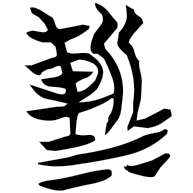 戰國文字 Warring States · 戰國.楚
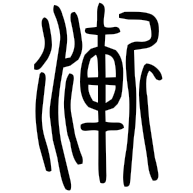 篆文 seal
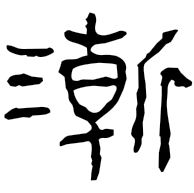 隸書 clerical · 西漢
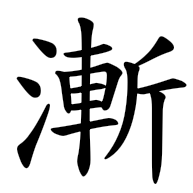 楷書 regular
Legge's note (1882)
Legge's title for the hexagram: gradual advance.
LIII. Kien is ordinarily used in the sense of gradually; but there is connected with that the idea also of progress or advance. The element of meaning in the character is the symbol of water; and the whole of it denotes gradual advance, like the soaking in of water. Three hexagrams contain in them the idea of advance,—Ȝin (35), Shăng (46), and this Kien; but each has its peculiarity of meaning, and that of Kien is the gradual manner in which the advance takes place. The subject then of the hexagram is the advance of men to offices in the state, how it should take place gradually and by successive steps, as well as on certain other conditions that may be gathered from the Text. P. Regis gives this exposition of the subject, as taken by him from the symbolism, which he ascribes to Confucius:—‘Viri probi, seu republica digni, in virtutis soliditate instituendi sunt a sapiente, bonisque regulis ut altis radicibus firmandi, nec alii ad rempublicam tractandam promovendi, nisi qui paulatim per varios minoresque gradus ad magnum hoc regimen periculo facto ascendere digni sint.’ He then illustrates this sentiment by the words of Pliny:—‘Eligetur multis experimentis eruditus, et qui futura possit ex praeteritis praevidere.’ But how does the lineal figure give the idea of a gradual advance? We shall see how it is attempted in the Great Symbolism to get this from the component trigrams. The account there is not satisfactory; and still less so is what else I have been able to find on the subject. E.g., the trigrams were originally Khwăn and Khien; but the third line of Khwăn and the first of Khien have changed places; and the trigrams now denote ‘the youngest son,’ and ‘the eldest daughter.’ If all this, which is a mere farrago, were admitted, it would not help us to the idea of an advance. Again, the lines 2, 3, 4, 5 are all in the places proper to them as strong or weak; we ascend by them as by regular steps to the top of the hexagram; and this, it is said, gives the notion of the gradual steps of the advance. But neither does this carry conviction with it to the mind. We must leave the question. King Wăn, for reasons which we cannot discover, or without such reasons, determined that the hexagram Kien should denote the gradual advance of men to positions of influence and office. The marriage of a young lady is mentioned in the Thwan as an illustration of an important event taking place with various preliminary steps, continued from its initiation to its consummation. But all must be done in an orderly and correct manner. And so must it be with the rise of a man in the service of the state. The goose from the most ancient times played an important part in the marriage ceremonies of the Chinese; and this may have suggested the use of it in the symbolism of the different lines. Its habits as a bird of passage, and flying in processional order, admirably suited the writer’s purpose. In paragraph 1 it appears for the first time in the season approaching the shore. Then comes the real subject of the line; and the facts of its being weak, and without a proper correlate, agree with, if they do not suggest, what is said about him, and the caution added. The geese have advanced in line 2, and so has the officer, though he is not mentioned. The line is weak or humble, and central, and has a proper correlate in 5. Hence comes the good auspice. Line 3 is strong, and has passed the central place, to the top of the lower trigram, and has not a proper correlate in 6. Its subject is likely to be violent and at the same time unsuccessful in his movements. He is like a husband who does not care for his wife, or a wife who does not care for her child. But in the case supposed, his strength in the end would be useful. The web-footed goose is not suited for taking hold on the branches; but on flat branches it can rest. Line 4, weak, but in an even place, does not promise a good auspice for its subject; but it is the first line in the trigram of humility, and it is concluded that he will not fall into error. Line 5 is a strong line in the ruler’s seat; and yet it appears here as the symbol of a wife. Somehow its subject has been at variance with, and kept in disgrace by, calumniating enemies such as the plunderers of paragraph 3; but things come right in the end. The wife, childless for three years, becomes at last a mother; and there is good fortune. The subject of line 6 has reached the top of the hexagram. There is no more advance for him; and he has no correlate. But he may still do some good work for the state, and verify the auspice derived from the ornamental plumes of the geese.
Sources
- Chinese text: 周易, 維基文庫, page (revision 2560535); the text is public domain, the site's edits CC BY-SA 4.0.
- English: James Legge, The Yî King, Sacred Books of the East vol. XVI, Oxford 1882 (public domain), where this hexagram is “Kien”.
- Glyph images: 小學堂 字形演變, Academia Sinica (CC0 1.0).
- Pinyin: Unihan (Unicode License v3) with this site's readings for the classical cases. English gloss, relations, the idiom glosses, the English of the chronicle passages and the plain reading: this site.