- The 64
- Hexagram 17
17 隨 Following
震 Thunder below, 兌 Lake above
Thunder resting inside the lake: following, going along with the time. The text says it gets through greatly, with firmness, without blame; the lines are about whom one follows.
Tap a line of the figure to see where it leads when it changes. Cast for a question of your own. New here? What the I Ching is, coming from tarot.
This site's reading
卦辭 元亨,利貞,无咎: great, penetrating, advantageous to be firm, no blame. The firm trigram has placed itself under the yielding one; following begins with the strong giving way.
彖 The commentary: the firm comes and places itself below the yielding; movement with pleasure, that is following. Great success with firmness, no blame, and all under heaven follows the time. "Great is the meaning of following the time" (隨時之義大矣哉).
大象 Thunder in the lake: the noble person at nightfall goes in to rest and eat. Following the time includes following the evening.
爻 The lines: the office changes, firmness is good, going out the gate to mix brings achievement; clinging to the boy and losing the man; clinging to the man and losing the boy, following with gain, staying firm; followed and gaining, firmness and yet evil, sincerity on the way and clarity, what blame; sincerity in what is excellent, good; and at the top bound and held fast, the king making offering at the western mountain. The middle lines are the choice: the small attachment or the mature one.
If your question is about
- A relationship
- Whom you follow is the question: the boy or the man (lines 2 and 3). Sincerity in what is excellent (line 5) is good following.
- Work
- Go along with the time and the able; out the gate to mix brings achievement (line 1). Being followed needs sincerity and clarity (line 4).
- A decision
- Follow rather than lead this one, and follow the better thing. Firmness keeps it blameless.
- No line changing
- Following as a state: the strong resting under the yielding. Rest at nightfall (the Image); this is not a time to drive.
Written from the text above and checked against it by Lun (2026-10-24). It is a way of reading the hexagram, not a prediction.
The text, with Legge
Judgment 卦辭
隨:元亨。利貞。无咎。
Sui indicates that (under its conditions) there will be great progress and success. But it will be advantageous to be firm and correct. There will (then) be no error. (Legge, 1882)
Commentary on the Judgment 彖
隨,剛來而下柔,動而說,隨。大亨貞,无咎,而天下隨時,隨時之義大矣哉!
The Image 大象
澤中有雷,隨;君子以嚮晦入宴息。
The six lines
Line 1 初九
官有渝,貞吉。出門交有功。
The first line, undivided, shows us one changing the object of his pursuit; but if he be firm and correct, there will be good fortune. Going beyond (his own) gate to find associates, he will achieve merit. (Legge, 1882)
The Image 小象
官有渝,從正吉也。出門交有功,不失也。
Changing, this line leads to 45 萃 Cuì.
Line 2 六二
係小子,失丈夫。
The second line, divided, shows us one who cleaves to the little boy, and lets go the man of age and experience. (Legge, 1882)
The Image 小象
系小子,弗兼與也。
Changing, this line leads to 58 兌 Duì.
Line 3 六三
係丈夫,失小子。隨,有求得利,居貞。
The third line, divided, shows us one who cleaves to the man of age and experience, and lets go the little boy. Such following will get what it seeks; but it will be advantageous to adhere to what is firm and correct. (Legge, 1882)
The Image 小象
系丈夫,志舍下也。
Changing, this line leads to 49 革 Gé.
Line 4 九四
隨有獲,貞凶。有孚在道,以明,何咎。
The fourth line, undivided, shows us one followed and obtaining (adherents). Though he be firm and correct, there will be evil. If he be sincere (however) in his course, and make that evident, into what error will he fall? (Legge, 1882)
The Image 小象
隨有獲,其義凶也。有孚在道,明功也。
Changing, this line leads to 3 屯 Zhūn.
Line 5 九五
孚于嘉,吉。
The fifth line, undivided, shows us (the ruler) sincere in (fostering all) that is excellent. There will be good fortune. (Legge, 1882)
The Image 小象
孚于嘉,吉;位正中也。
Changing, this line leads to 51 震 Zhèn.
Line 6 上六
拘係之,乃從維之。王用亨于西山。
The topmost line, divided, shows us (that sincerity) firmly held and clung to, yea, and bound fast. (We see) the king with it presenting his offerings on the western mountain. (Legge, 1882)
The Image 小象
拘系之,上窮也。
Changing, this line leads to 25 无妄 Wú Wàng.
In history
The 左傳 and 國語, the chronicles of the sixth to fifth centuries BC, record real casts of the Changes and what came of them. One of them gave this hexagram.
575 BC: 穆姜, dowager of 魯, on being confined to the eastern palace
Asked: Will I get out of here? The stalks gave 52 艮 turning to 17 隨.
是謂艮之隨.隨其出也.君必速出.The scribe read 艮之八 as 艮 turning into 隨, and 隨 means following, going out: she would soon be released. 穆姜 refused the comfort. 隨 promises 元亨利貞 without fault only to someone with those four virtues; a woman who had joined a plot, harmed the state and left her place had none, so she would die there.
She stayed in the eastern palace and died there, in 564 BC, as she had said.
左傳 襄公九年, 維基文庫 (revision 9172568). 艮之八 is the old notation: 艮 with five lines changing and only the second, a yin line (八), unmoved, which the scribe resolves as 隨. No single moving line can be given. The year is that of her confinement after the 僑如 plot of 成公十六年; the 左傳 tells the story under the year of her death. This page's text omits 無 in 無咎 twice; the received 隨 judgment reads 元亨利貞,无咎.
The chronicles' diviners read from oracle texts of their own time; where their words match our clause text the note says so, and where they do not, it says that. None of this is a claim that the text foretold the event.
Related hexagrams
Where the name comes from
隨
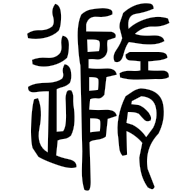 篆文 seal
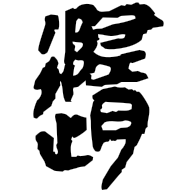 隸書 clerical · 秦
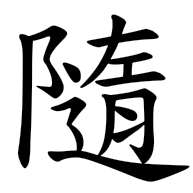 楷書 regular
Legge's note (1882)
Legge's title for the hexagram: following.
XVII. Sui symbolises the idea of following. It is said to follow Yü, the symbol of harmony and satisfaction. Where there are these conditions men are sure to follow; nor will they follow those in whom they have no complacency. The hexagram includes the cases where one follows others, and where others follow him; and the auspice of great progress and success is due to this flexibility and applicability of it. But in both cases the following must be guided by a reference to what is proper and correct. See the notes on the Thwan and the Great Symbolism. Line 1 is strong, and lord of the lower trigram. The weak lines ought to follow it; but here it is below them, in the lowest place of the figure. This gives rise to the representation of one changing his pursuit. Still through the native vigour indicated by the line being strong, and in its correct place, its subject will be fortunate. Going beyond his gate to find associates indicates his public spirit, and superiority to selfish considerations. Line 2 is weak. Its proper correlate is the strong 5; but it prefers to cleave to the line below, instead of waiting to follow 5. Hence the symbolism of the text, the bad omen of which needs not to be mentioned. Line 3 is also weak, but it follows the strong line above it and leaves line 1, reversing the course of 2;—with a different issue. It is weak, however, and 4 is not its proper correlate; hence the conclusion of the paragraph is equivalent to a caution. Line 4 is strong, and in the place of a great minister next the ruler in 5. But his having adherents may be injurious to the supreme and sole authority of that ruler, and only a sincere loyalty will save him from error and misfortune. Line 5 is strong, and in its correct place, with 2 as its proper correlate; thus producing the auspicious symbolism. The issue of the hexagram is seen in line 6; which represents the ideal of following, directed by the most sincere adherence to what is right. This influence not only extends to men, but also to spiritual beings. ‘The western hill’ is mount Khî, at the foot of which was the original settlement of the house of Kâu, in B.C. 1325. The use of the name ‘king’ here brings us down from Wăn into the time of king Wû at least.
Sources
- Chinese text: 周易, 維基文庫, page (revision 10645020); the text is public domain, the site's edits CC BY-SA 4.0.
- English: James Legge, The Yî King, Sacred Books of the East vol. XVI, Oxford 1882 (public domain), where this hexagram is “Sui”.
- Glyph images: 小學堂 字形演變, Academia Sinica (CC0 1.0).
- Pinyin: Unihan (Unicode License v3) with this site's readings for the classical cases. English gloss, relations, the idiom glosses, the English of the chronicle passages and the plain reading: this site.