- The 64
- Hexagram 51
51 震 Thunder
震 Thunder below, 震 Thunder above
Thunder over thunder: the shock, the arousing. The text says it gets through, that the shock comes with trembling and then laughter, and that it startles a hundred miles while the ladle and the wine do not spill.
Tap a line of the figure to see where it leads when it changes. Cast for a question of your own. New here? What the I Ching is, coming from tarot.
This site's reading
卦辭 震來虩虩,笑言啞啞。震驚百里,不喪匕鬯: the shock comes, trembling; then laughing talk. It alarms a hundred miles, and the sacrificial ladle and wine are not spilled. The hexagram is the one who keeps his hands steady in the thunderclap.
彖 The commentary: the trembling brings blessing because fear leads to it; the laughter comes after, when there is a rule to follow. Alarming the far and frightening the near: one who can go out and keep the ancestral temple and the altars, and be master of the sacrifice.
大象 Thunder repeated: the noble person in fear and trembling sets himself in order and examines himself. The shock is used for self-correction.
爻 The lines: the shock comes trembling, then laughing talk, good; the shock comes with danger, treasure lost, up the nine hills, do not chase, in seven days regained; the shock leaves one distraught, but moving on through it, no harm; the shock sunk in mud; the shock going and coming, danger, but nothing lost, there is work to do; and at the top the shock in dismay, eyes darting, going brings evil; if it strikes the neighbour and not oneself, no blame, though there are words about a marriage. The first line is the model: fear, then laughter, then a steady hand.
If your question is about
- A relationship
- A shock between you; the model is the first line, trembling then laughter. Do not chase what was scattered (line 2); it returns.
- Work
- Keep the ladle steady when the thunder hits (the Judgment); use the fear to examine yourself (the Image). Mud (line 4) is the failure.
- A decision
- Move on through the shock (line 3), not from dismay (line 6). Hold the hands steady; there is work to do (line 5).
- No line changing
- Thunder as a state: shocks that keep coming. Fear, order, examination, every time; and a steady hand at the altar.
Written from the text above and checked against it by Lun (2026-10-24). It is a way of reading the hexagram, not a prediction.
The text, with Legge
Judgment 卦辭
震:亨。震來虩虩,笑言啞啞。震驚百里,不喪匕鬯。
Kăn gives the intimation of ease and development. When (the time of) movement (which it indicates) comes, (the subject of the hexagram) will be found looking out with apprehension, and yet smiling and talking cheerfully. When the movement (like a crash of thunder) terrifies all within a hundred lî, he will be (like the sincere worshipper) who is not (startled into) letting go his ladle and (cup of) sacrificial spirits. (Legge, 1882)
Commentary on the Judgment 彖
震,亨。震來虩虩,恐致福也。笑言啞啞,後有則也。震驚百里,驚遠而懼邇也。出可以守宗廟社稷,以為祭主也。
The Image 大象
洊雷,震;君子以恐懼修省。
The six lines
Line 1 初九
震來虩虩,後笑言啞啞,吉。
The first line, undivided, shows its subject, when the movement approaches, looking out and around with apprehension, and afterwards smiling and talking cheerfully. There will be good fortune. (Legge, 1882)
The Image 小象
震來虩虩,恐致福也。笑言啞啞,後有則也。
Changing, this line leads to 16 豫 Yù.
Line 2 六二
震來厲,億喪貝,躋于九陵,勿逐,七日得。
The second line, divided, shows its subject, when the movement approaches, in a position of peril. He judges it better to let go the articles (in his possession), and to ascend a very lofty height. There is no occasion for him to pursue after (the things he has let go); in seven days he will find them. (Legge, 1882)
The Image 小象
震來厲,乘剛也。
Changing, this line leads to 54 歸妹 Guī Mèi.
Line 3 六三
震蘇蘇,震行无眚。
The third line, divided, shows its subject distraught amid the startling movements going on. If those movements excite him to (right) action, there will be no mistake. (Legge, 1882)
The Image 小象
震蘇蘇,位不當也。
Changing, this line leads to 55 豐 Fēng.
Line 4 九四
震遂泥。
The fourth line, undivided, shows its subject, amid the startling movements, supinely sinking (deeper) in the mud. (Legge, 1882)
The Image 小象
震遂泥,未光也。
Changing, this line leads to 24 復 Fù.
Line 5 六五
震往來厲,億无喪,有事。
The fifth line, divided, shows its subject going and coming amidst the startling movements (of the time), and always in peril; but perhaps he will not incur loss, and find business (which he can accomplish). (Legge, 1882)
The Image 小象
震往來厲,危行也。其事在中,大无喪也。
Changing, this line leads to 17 隨 Suí.
Line 6 上六
震索索,視矍矍,征凶。震不于其躬,于其鄰,无咎。婚媾有言。
The topmost line, divided, shows its subject, amidst the startling movements (of the time), in breathless dismay and looking round him with trembling apprehension. If he take action, there will be evil. If, while the startling movements have not reached his own person and his neighbourhood, (he were to take precautions), there would be no error, though his relatives might (still) speak against him. (Legge, 1882)
The Image 小象
震索索,中未得也。雖凶无咎,畏鄰戒也。
Changing, this line leads to 21 噬嗑 Shì Kè.
Related hexagrams
Where the name comes from
震
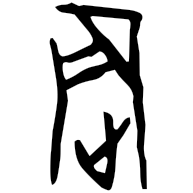 甲骨文 oracle bone · 商
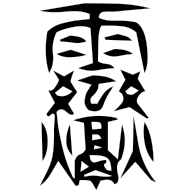 篆文 seal
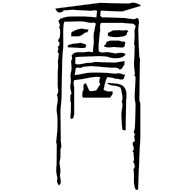 隸書 clerical
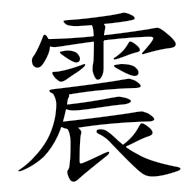 楷書 regular
Legge's note (1882)
Legge's title for the hexagram: thunder; movement.
LI. Kăn among the trigrams represents thunder, and, according to Wăn’s arrangement and significance of them, ‘the oldest son.’ It is a phonetic character in which the significant constituent is Yü, meaning rain, and with which are formed most characters that denote atmospherical phenomena. The hexagram is formed of the trigram Kăn redoubled, and may be taken as representing the crash or peal of thunder; but we have seen that the attribute or virtue of the trigram is ‘moving, exciting power;’ and thence, symbolically, the character is indicative of movement taking place in society or in the kingdom. This is the meaning of the hexagram; and the subject is the conduct to be pursued in a time of movement—such as insurrection or revolution—by the party promoting, and most interested in, the situation. It is shown how he ought to be aware of the dangers of the time, and how by precaution and the regulation of himself he may overcome them. The indication of a successful issue given by the figure is supposed to be given by the undivided line at the bottom of the trigram. The subject of it must be superior to the subjects of the two divided lines above. It is in the idea of the hexagram that he should be moving and advancing;—and what can his movement be but successful? The next sentence shows him sensible of the danger of the occasion, but confident and self-possessed. The concluding sentence shows him rapt in his own important affairs, like a sincere worshipper, thinking only of the service in which he is engaged. Such a symbol is said to be suggested by Wăn’s significance of Kăn as ‘the oldest son (page 33).’ It is his to succeed to his father, and the hexagram, as following Ting, shows him presiding over the sacrifices that have been prepared in the caldron. This is too fanciful. What is said on line 1 is little more than a repetition of the principal part of the Thwan. The line is undivided, and gives the auspice of good fortune. ‘The position of peril’ to the subject of line 2 is suggested, as Appendix II says, by its position, immediately above 1. But the rest of the symbolism is obscure, and Kû Hsî says he does not understand it. The common interpretation appears in the version. The subject of the line does what he can to get out of danger; and finally, as is signified by the central position of the line, the issue is better than could have been expected. On the specification of ‘seven days,’ see what is said in the treatise on the Thwan of hexagram 24. On its use here Khăng-ȝze says:—‘The places of a diagram amount to 6. The number 7 is the first of another. When the movement symbolised by Kăn is gone by, things will be as they were before.’ Line 3 is divided, and where an undivided line should be; but if its subject move on to the fourth place, which would be right for him, the issue will not be bad. The 4th line, however, has a bad auspice of its own. It is undivided in an even place, and it is pressed by the divided line on either side, hence its subject is represented as supinely sinking in the mud. Line 5 is divided, in an odd place, and that in which the action of the hexagram may be supposed to be concentrated. Hence its subject is always in peril; but his central position indicates safety in the end. Line 6 is weak, and has to abide the concluding terrors of the movement. Action on the part of its subject is sure to be evil. If, however, he were to take precautions, he might escape with only the censures of his relatives. But I do not see anything in the figure to indicate this final symbolism. The writer, probably, had a case in his mind, which it suited; but what that was we do not know.
Sources
- Chinese text: 周易, 維基文庫, page (revision 10644930); the text is public domain, the site's edits CC BY-SA 4.0.
- English: James Legge, The Yî King, Sacred Books of the East vol. XVI, Oxford 1882 (public domain), where this hexagram is “Kăn”.
- Glyph images: 小學堂 字形演變, Academia Sinica (CC0 1.0).
- Pinyin: Unihan (Unicode License v3) with this site's readings for the classical cases. English gloss, relations, the idiom glosses, the English of the chronicle passages and the plain reading: this site.