- The 64
- Hexagram 20
20 觀 Viewing
坤 Earth below, 巽 Wind above
Wind moving over the earth: viewing, and being viewed. The text's image is the worshipper who has washed his hands and not yet made the offering: sincere, grave, watched.
Tap a line of the figure to see where it leads when it changes. Cast for a question of your own. New here? What the I Ching is, coming from tarot.
This site's reading
卦辭 盥而不薦,有孚顒若: hands washed, the offering not yet presented, sincerity and a dignified bearing. The moment before the act, when the attention is highest, is the whole Judgment.
彖 The commentary: the great view is above, compliant and gentle, central and correct, viewing the world; those below look up and are transformed. Viewing heaven's spirit-way, the seasons do not err; the sage sets his teaching by it and the world submits.
大象 Wind over the earth: the former kings surveyed the regions, viewed the people and set up teaching. Viewing is a ruler's travel as much as a seer's gaze.
爻 The lines: a child's viewing, no blame in a small man, regret in a noble one; peeping through the door, fit only for a woman's firmness, says the old text; viewing one's own life, to advance or withdraw; viewing the glory of the state, fit to be a guest of the king; viewing one's own life, and a noble person is without blame; and at the top viewing their life, the noble person without blame. The lines climb from peeping to seeing oneself whole.
If your question is about
- A relationship
- Look before acting, and at yourself first (lines 3 and 5): the washed hands, the offering not yet made. Peeping (line 2) is small.
- Work
- Survey the ground, view the state's light (line 4), and let the looking set the teaching. Not a time to act; a time to see.
- A decision
- Hold the moment before the offering: sincere, grave, watching. Advance or withdraw on what you see in your own course (line 3).
- No line changing
- Viewing that stays viewing. The dignity of the washed hands is itself the counsel; being seen like that changes those who see.
Written from the text above and checked against it by Lun (2026-10-24). It is a way of reading the hexagram, not a prediction.
The text, with Legge
Judgment 卦辭
觀:盥而不薦,有孚顒若。
Kwân shows (how he whom it represents should be like) the worshipper who has washed his hands, but not (yet) presented his offerings;—with sincerity and an appearance of dignity (commanding reverent regard). (Legge, 1882)
Commentary on the Judgment 彖
大觀在上,順而巽,中正以觀天下。觀,盥而不薦,有孚顒若,下觀而化也。觀天之神道,而四時不忒,聖人以神道設教,而天下服矣。
The Image 大象
風行地上,觀;先王以省方,觀民設教。
The six lines
Line 1 初六
童觀,小人无咎,君子吝。
The first line, divided, shows the looking of a lad:—not blamable in men of inferior rank, but matter for regret in superior men. (Legge, 1882)
The Image 小象
初六童觀,小人道也。
Changing, this line leads to 42 益 Yì.
Line 2 六二
窺觀,利女貞。
The second line, divided, shows one peeping out from a door. It would be advantageous if it were (merely) the firm correctness of a female. (Legge, 1882)
The Image 小象
窺觀女貞,亦可醜也。
Changing, this line leads to 59 渙 Huàn.
Line 3 六三
觀我生,進退。
The third line, divided, shows one looking at (the course of) his own life, to advance or recede (accordingly). (Legge, 1882)
The Image 小象
觀我生,進退;未失道也。
Changing, this line leads to 53 漸 Jiàn.
Line 4 六四
觀國之光,利用賓于王。
The fourth line, divided, shows one contemplating the glory of the kingdom. It will be advantageous for him, being such as he is, (to seek) to be a guest of the king. (Legge, 1882)
The Image 小象
觀國之光,尚賓也。
Changing, this line leads to 12 否 Pǐ.
Line 5 九五
觀我生,君子无咎。
The fifth line, undivided, shows its subject contemplating his own life(-course). A superior man, he will (thus) fall into no error. (Legge, 1882)
The Image 小象
觀我生,觀民也。
Changing, this line leads to 23 剝 Bō.
Line 6 上九
觀其生,君子无咎。
The sixth line, undivided, shows its subject contemplating his character to see if it be indeed that of a superior man. He will not fall into error. (Legge, 1882)
The Image 小象
觀其生,志未平也。
Changing, this line leads to 8 比 Bǐ.
Words that came from it
Phrases a billion people use today began as clauses of this hexagram.
- 觀光
- to view the light of a state. The modern word for sightseeing and tourism is this line, shortened. From line 4: 觀國之光.
In history
The 左傳 and 國語, the chronicles of the sixth to fifth centuries BC, record real casts of the Changes and what came of them. One of them gave this hexagram.
672 BC: 陳厲公, for his young son 公子完 (敬仲)
Asked: What is in store for this boy? The stalks gave 20 觀 with line 4 changing, to 12 否.
是謂「觀國之光,利用賓于王。」代陳有國乎。不在此,其在異國;非此其身,在其子孫。The Zhou court scribe read the fourth line of 觀, 'beholding the glory of the state, fit to be a guest of the king', as a sign that the family would one day hold a state: not here in 陳, not in his own person, but in another state, one of the 姜 clan, and in his descendants.
公子完 fled to 齊 that year. His descendants, the 田 (陳) family, rose there; 田常 seized power in 481 BC and 田和 took the ducal title in 386 BC.
左傳 莊公二十二年, 維基文庫 (revision 9686138). The 左傳 tells the cast in retrospect (初); the year given is the year of the entry, when 公子完 left 陳. The passage reads the line text 觀國之光 as our received text has it.
The chronicles' diviners read from oracle texts of their own time; where their words match our clause text the note says so, and where they do not, it says that. None of this is a claim that the text foretold the event.
In the calendar
In the Han dynasty's 卦氣 tradition, which lays the hexagrams over the year, 觀 is one of the twelve sovereign hexagrams 消息卦: it governs the month that begins at 秋分, autumn equinox, and runs until 霜降 (frost's descent), the eighth month of the traditional year, the month of 酉. Four yin lines; two yang remain above, 'contemplating'.
The calendar is a later tradition about the hexagrams, not part of the text above.
Related hexagrams
Where the name comes from
觀
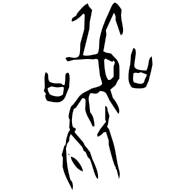 甲骨文 oracle bone · 商
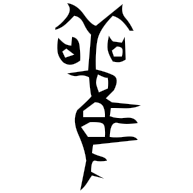 金文 bronze · 西周中期
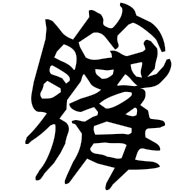 戰國文字 Warring States · 戰國.楚
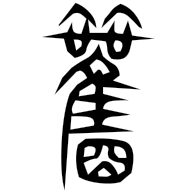 篆文 seal
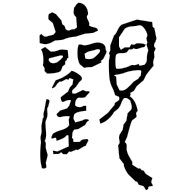 隸書 clerical · 西漢
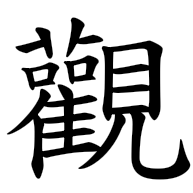 楷書 regular
Legge's note (1882)
Legge's title for the hexagram: showing; contemplating.
XX. The Chinese character Kwân, from which this hexagram is named, is used in it in two senses. In the Thwan, the first paragraph of the treatise on the Thwan, and the paragraph on the Great Symbolism, it denotes showing, manifesting; in all other places it denotes contemplating, looking at. The subject of the hexagram is the sovereign and his subjects, how he manifests himself to them, and how they contemplate him. The two upper, undivided, lines belong to the sovereign; the four weak lines below them are his subjects,—ministers and others who look up at him. Kwân is the hexagram of the eighth month. In the Thwan king Wăn symbolises the sovereign by a worshipper when he is most solemn in his religious service, at the commencement of it, full of sincerity and with a dignified carriage. Line 1 is weak, and in the lowest place, improper also for it;— the symbol of a thoughtless lad, who cannot see far, and takes only superficial views. Line 2 is also weak, but in its proper place, showing a woman, living retired, and only able to peep as from her door at the subject of the fifth line. But ignorance and retirement are proper in a woman. Line 3, at the top of the lower trigram Khwăn, and weak, must belong to a subject of the utmost docility, and will wish to act only according to the exigency of time and circumstances. Line 4, in the place proper to its weakness, is yet in immediate proximity to 5, representing the sovereign. Its subject is moved accordingly, and stirred to ambition. Line 5 is strong, and in the place of the ruler. He is a superior man, but this does not relieve him from the duty of self-contemplation or examination. There is a slight difference in the 6th paragraph from the 5th, which can hardly be expressed in a translation. By making a change in the punctuation, however, the different significance may be brought out. Line 6 is strong, and should be considered out of the work of the hexagram, but its subject is still possessed by the spirit of its idea, and is led to self-examination.
Sources
- Chinese text: 周易, 維基文庫, page (revision 10645159); the text is public domain, the site's edits CC BY-SA 4.0.
- English: James Legge, The Yî King, Sacred Books of the East vol. XVI, Oxford 1882 (public domain), where this hexagram is “Kwân”.
- Glyph images: 小學堂 字形演變, Academia Sinica (CC0 1.0).
- Pinyin: Unihan (Unicode License v3) with this site's readings for the classical cases. English gloss, relations, the idiom glosses, the English of the chronicle passages and the plain reading: this site.