- The 64
- Hexagram 59
59 渙 Dispersal
坎 Water below, 巽 Wind above
Wind moving over water, scattering it: dispersal, what has hardened breaking up. The text says it gets through, that the king goes to the temple, that the great stream can be crossed, and that firmness is advantageous.
Tap a line of the figure to see where it leads when it changes. Cast for a question of your own. New here? What the I Ching is, coming from tarot.
This site's reading
卦辭 亨,王假有廟,利涉大川,利貞: it gets through; the king arrives at the temple; advantageous to cross the great stream; firmness advantageous. Dispersal is answered by a centre, the temple, and by a crossing.
彖 The commentary: the firm comes and is not exhausted; the yielding gains its place outside and joins above. The king at the temple is the king in the centre; crossing the stream is riding on wood with success.
大象 Wind over water: the former kings made offerings to the Highest and set up temples. What scatters people is gathered again by rite.
爻 The lines: rescue with a strong horse, good, regret gone; in the dispersal, running to the support, regret gone; dispersing one's own self, no regret; dispersing the party, greatly good, a dispersal that becomes a hill, beyond ordinary thought; the great proclamation issued like sweat in the dispersal, the king's dwelling dispersed, no blame; and at the top dispersing the blood, going far off and out, no blame. Dispersal of the self (line 3) and of the faction (line 4) is what the text calls good.
If your question is about
- A relationship
- Something hardened is breaking up; the good lines disperse the self (line 3) and the faction (line 4), not the bond. Rescue early (line 1).
- Work
- Scatter the cliques and gather around the centre (the Judgment's temple). A proclamation issued like sweat (line 5) cannot be taken back.
- A decision
- Cross; the stream is open. Let go of what you are holding for yourself (line 3).
- No line changing
- Dispersal as a state: the wind keeps scattering. Keep the temple at the centre and go far from the blood (line 6).
Written from the text above and checked against it by Lun (2026-10-24). It is a way of reading the hexagram, not a prediction.
The text, with Legge
Judgment 卦辭
渙:亨,王假有廟,利涉大川,利貞。
Hwân intimates that (under its conditions) there will be progress and success. The king goes to his ancestral temple; and it will be advantageous to cross the great stream. It will be advantageous to be firm and correct. (Legge, 1882)
Commentary on the Judgment 彖
渙,亨。剛來而不窮,柔得位乎外而上同。王假有廟,王乃在中也。利涉大川,乘木有功也。
The Image 大象
風行水上,渙;先王以享于帝立廟。
The six lines
Line 1 初六
用拯馬壯,吉,悔亡。
The first line, divided, shows its subject engaged in rescuing (from the impending evil) and having (the assistance of) a strong horse. There will be good fortune. (Legge, 1882)
The Image 小象
初六之吉,順也。
Changing, this line leads to 61 中孚 Zhōng Fú.
Line 2 九二
渙奔其机,悔亡。
The second line, undivided, shows its subject, amid the dispersion, hurrying to his contrivance (for security). All occasion for repentance will disappear. (Legge, 1882)
The Image 小象
渙奔其机,得愿也。
Changing, this line leads to 20 觀 Guān.
Line 3 六三
渙其躬,无悔。
The third line, divided, shows its subject discarding any regard to his own person. There will be no occasion for repentance. (Legge, 1882)
The Image 小象
渙其躬,志在外也。
Changing, this line leads to 57 巽 Xùn.
Line 4 六四
渙其群,元吉。渙有丘,匪夷所思。
The fourth line, divided, shows its subject scattering the (different) parties (in the state); which leads to great good fortune. From the dispersion (he collects again good men standing out, a crowd) like a mound, which is what ordinary men would not have thought of. (Legge, 1882)
The Image 小象
渙其群,元吉;光大也。
Changing, this line leads to 6 訟 Sòng.
Line 5 九五
渙汗其大號,渙王居,无咎。
The fifth line, undivided, shows its subject amidst the dispersion issuing his great announcements as the perspiration (flows from his body). He scatters abroad (also) the accumulations in the royal granaries. There will be no error. (Legge, 1882)
The Image 小象
王居无咎,正位也。
Changing, this line leads to 4 蒙 Méng.
Line 6 上九
渙其血,去逖出,无咎。
The topmost line, undivided, shows its subject disposing of (what may be called) its bloody wounds, and going and separating himself from its anxious fears. There will be no error. (Legge, 1882)
The Image 小象
渙其血,遠害也。
Changing, this line leads to 29 坎 Kǎn.
Words that came from it
Phrases a billion people use today began as clauses of this hexagram.
- 匪夷所思
- not what an ordinary person would think of. Today it means unbelievable or bizarre; in the text it praises a plan beyond common imagination. From line 4: 匪夷所思.
Related hexagrams
Where the name comes from
渙
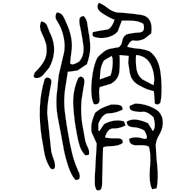 篆文 seal
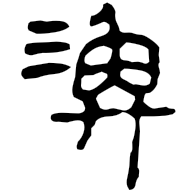 隸書 clerical · 西漢
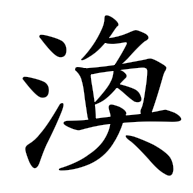 楷書 regular
Legge's note (1882)
Legge's title for the hexagram: dissipation or dispersion.
LIX. Hwân, the name of this hexagram, denotes a state of dissipation or dispersion. It is descriptive primarily of men’s minds alienated from what is right and good. This alienation is sure to go on to disorder in the commonwealth; and an attempt is made to show how it should be dealt with and remedied. The figure is made up of one of the trigrams for water and over it that for wind. Wind moving over water seems to disperse it, and awakes naturally in the beholder the idea of dissipation. The intimation of progress and success is supposed to be given by the strong lines occupying the central places. The king goes to the ancestral temple, there to meet with the spirits of his ancestors. His filial piety moves them by the sincerity of its manifestation. Those spirits come and are present. Let filial piety —in our language, let sincere religion—rule in men’s minds, and there will be no alienation in them from what is right and good or from one another. And if the state of the country demand a great or hazardous enterprise, let it be undertaken. But whatever is done, must be done with due attention to what is right, firmly and correctly. Line 1, at the commencement of the hexagram, tells us that the evil has not yet made great progress, and that dealing with it will be easy. But the subject of the line is weak, and in an odd place. He cannot cope with the evil himself. He must have help, and he finds that in a strong horse, which description is understood to be symbolical of the subject of the strong second line. Line 2 is strong, but in an even place. That place is, indeed, the central, but the attribute of the lower trigram Khan is peril. These conditions indicate evil, and action will be dangerous; but the subject of 2 looks to 1 below him, and takes shelter in union with its subject. Since the commentary of Khăng-ȝze, this has been the interpretation of the line. Line 3 is weak, and in an odd place. A regard for himself that would unfit its subject for contributing any service to the work of the hexagram might be feared; but he discards that regard, and will do nothing to be repented of. There is a change of style in the Chinese text at this point. As Wang Shăn-ȝze (Yüan dynasty) says:—‘Here and henceforth the scattering is of what should be scattered, that what should not be scattered may be collected.’ Line 4, though weak, is in its correct place, and adjoins the strong 5, which is in the ruler’s seat. The subject of 4, therefore, will fitly represent the minister, to whom it belongs to do a great part in remedying the evil of dispersion. And this he does. He brings dissentient partizanship to an end; and not satisfied with that, he collects multitudes of those who had been divided into a great body so that they stand out conspicuous like a hill. Line 5 gives us the action of the ruler himself;—by his proclamations, and by his benevolence. Kû Hsî and other critics enlarge on the symbolism of the perspiration, which they think much to the point. P. Regis avoids it, translating—‘Ille, magnas leges dissipans, facit ut penetrent(ur?).’ Canon McClatchie has an ingenious and original, so far as my Chinese reading goes, note upon it:—‘As sweat cures fevers, so do proclamations cure rebellions. Both of these translators miss the meaning of the other instance of the king’s work. Line 6 is occupied by a strong line, which has a proper correlate in 3; but 3 is at the top of the trigram of peril. The subject of 6 hurries away from association with the subject of it, but does so in the spirit of the hexagram, so that there is no error or blame attaching to him.
Sources
- Chinese text: 周易, 維基文庫, page (revision 10647580); the text is public domain, the site's edits CC BY-SA 4.0.
- English: James Legge, The Yî King, Sacred Books of the East vol. XVI, Oxford 1882 (public domain), where this hexagram is “Hwân”.
- Glyph images: 小學堂 字形演變, Academia Sinica (CC0 1.0).
- Pinyin: Unihan (Unicode License v3) with this site's readings for the classical cases. English gloss, relations, the idiom glosses, the English of the chronicle passages and the plain reading: this site.