- The 64
- Hexagram 12
12 否 Blocked
坤 Earth below, 乾 Heaven above
Earth below, heaven above, each going its own way: blocked. The text says this is no time for the noble person's firmness to prosper; the great goes, the small comes.
Tap a line of the figure to see where it leads when it changes. Cast for a question of your own. New here? What the I Ching is, coming from tarot.
This site's reading
卦辭 否之匪人: blocked, and not the right people. Unfavourable to the noble person's firmness; the great goes, the small comes. The mirror of Peace: the same two trigrams, turned so that they part.
彖 The commentary: heaven and earth do not join and all things do not pass through; above and below do not join and there is no state under heaven. Yin within and yang without, the small man within and the noble person without: the small man's way grows, the noble person's wanes.
大象 Heaven and earth not joining: the noble person keeps virtue frugal to avoid the trouble, and will not be honoured with rank or pay. In a blocked time, do not take the salary.
爻 The lines: grass pulled up with its roots, firm and good, it gets through; bearing and obeying, good for the small man, blocked for the great; bearing shame; a mandate, no blame, and those of one's kind share the blessing; the block rests, good for the great person, "it is lost, it is lost", tied to a clump of mulberry; and at the top the block overturned, first blocked, then joy. The bottom lines endure; the top ones end it.
If your question is about
- A relationship
- Not the right people, or not the right time: the great withdraw rather than press. The block overturns at the top, in its time.
- Work
- Do not take the honours or the pay of a blocked time (the Image). Keep virtue frugal, your kind close; the turn is line 4.
- A decision
- Hold back. The noble person's firmness does not prosper here; wait for the mandate (line 4) and the block's rest (line 5).
- No line changing
- A block that does not move. Frugal, quiet, among your own kind: endurance without bitterness, tied to the mulberry.
Written from the text above and checked against it by Lun (2026-10-24). It is a way of reading the hexagram, not a prediction.
The text, with Legge
Judgment 卦辭
否之匪人,不利君子貞,大往小來。
In Phî there is the want of good understanding between the (different classes of) men, and its indication is unfavourable to the firm and correct course of the superior man. We see in it the great gone and the little come. (Legge, 1882)
Commentary on the Judgment 彖
否之匪人,不利君子貞,大往小來。則是天地不交而萬物不通也,上下不交而天下无邦也。內陰而外陽,內柔而外剛,內小人而外君子,小人道長,君子道消也。
The Image 大象
天地不交,否;君子以儉德辟難,不可榮以祿。
The six lines
Line 1 初六
拔茅茹以其彙,貞吉。亨。
The first line, divided, suggests the idea of grass pulled up, and bringing with it other stalks with whose roots it is connected. With firm correctness (on the part of its subject), there will be good fortune and progress. (Legge, 1882)
The Image 小象
拔茅貞吉,志在君也。
Changing, this line leads to 25 无妄 Wú Wàng.
Line 2 六二
包承,小人吉,大人否。亨。
The second line, divided, shows its subject patient and obedient. To the small man (comporting himself so) there will be good fortune. If the great man (comport himself) as the distress and obstruction require, he will have success. (Legge, 1882)
The Image 小象
大人否,亨。不亂羣也。
Changing, this line leads to 6 訟 Sòng.
Line 3 六三
包羞。
The third line, divided, shows its subject ashamed of the purpose folded (in his breast). (Legge, 1882)
The Image 小象
包羞,位不當也。
Changing, this line leads to 33 遯 Dùn.
Line 4 九四
有命,无咎,疇離祉。
The fourth line, undivided, shows its subject acting in accordance with the ordination (of Heaven), and committing no error. His companions will come and share in his happiness. (Legge, 1882)
The Image 小象
有命无咎,志行也。
Changing, this line leads to 20 觀 Guān.
Line 5 九五
休否,大人吉。其亡其亡,繫于包桑。
In the fifth line, undivided, we see him who brings the distress and obstruction to a close,—the great man and fortunate. (But let him say), ‘We may perish! We may perish!’ (so shall the state of things become firm, as if) bound to a clump of bushy mulberry trees. (Legge, 1882)
The Image 小象
大人之吉,位正當也。
Changing, this line leads to 35 晉 Jìn.
Line 6 上九
傾否,先否後喜。
The sixth line, undivided, shows the overthrow (and removal of) the condition of distress and obstruction. Before this there was that condition. Hereafter there will be joy. (Legge, 1882)
The Image 小象
否終則傾,何可長也。
Changing, this line leads to 45 萃 Cuì.
Words that came from it
Phrases a billion people use today began as clauses of this hexagram.
- 否極泰來
- when 否 reaches its end, 泰 arrives. The commonest of all: after the worst, things turn. It is made of the names of hexagrams 11 and 12, which are each other turned upside down. From the name.
In history
The 左傳 and 國語, the chronicles of the sixth to fifth centuries BC, record real casts of the Changes and what came of them. One of them gave this hexagram.
672 BC: 陳厲公, for his young son 公子完 (敬仲)
Asked: What is in store for this boy? The stalks gave 20 觀 with line 4 changing, to 12 否.
是謂「觀國之光,利用賓于王。」代陳有國乎。不在此,其在異國;非此其身,在其子孫。The Zhou court scribe read the fourth line of 觀, 'beholding the glory of the state, fit to be a guest of the king', as a sign that the family would one day hold a state: not here in 陳, not in his own person, but in another state, one of the 姜 clan, and in his descendants.
公子完 fled to 齊 that year. His descendants, the 田 (陳) family, rose there; 田常 seized power in 481 BC and 田和 took the ducal title in 386 BC.
左傳 莊公二十二年, 維基文庫 (revision 9686138). The 左傳 tells the cast in retrospect (初); the year given is the year of the entry, when 公子完 left 陳. The passage reads the line text 觀國之光 as our received text has it.
The chronicles' diviners read from oracle texts of their own time; where their words match our clause text the note says so, and where they do not, it says that. None of this is a claim that the text foretold the event.
In the calendar
In the Han dynasty's 卦氣 tradition, which lays the hexagrams over the year, 否 is one of the twelve sovereign hexagrams 消息卦: it governs the month that begins at 處暑, end of heat, and runs until 秋分 (autumn equinox), the seventh month of the traditional year, the month of 申. Three yin below three yang: 否, the inverse of 泰.
The calendar is a later tradition about the hexagrams, not part of the text above.
Related hexagrams
Where the name comes from
否
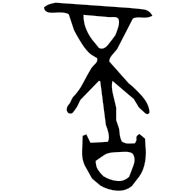 金文 bronze · 西周晚期
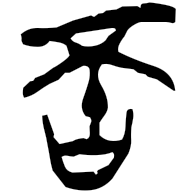 戰國文字 Warring States · 戰國.楚
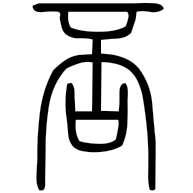 篆文 seal
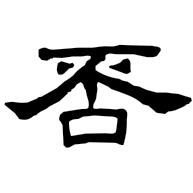 隸書 clerical · 東漢
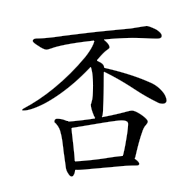 楷書 regular
Legge's note (1882)
Legge's title for the hexagram: .
XII. The form of Phî, it will be seen, is exactly the opposite of that of Thâi. Much of what has been said on the interpretation of that will apply to this, or at least assist the student in making out the meaning of its symbolism. Phî is the hexagram of the seventh month. Genial influences have done their work, the processes of growth are at an end. Henceforth increasing decay must be looked for. Naturally we should expect the advance of the subject of the first of the three weak lines to lead to evil; but if he set himself to be firm and correct, he will bring about a different issue. Patience and obedience are proper for the small man in all circumstances. If the great man in difficulty yet cherish these attributes, he will soon have a happy issue out of the distress. The third line is weak. Its place is odd, and therefore for it incorrect. Its subject would vent his evil purpose, but has not strength to do so. He is left therefore to the shame which he ought to feel without a word of warning. Does the ming of the fourth line mean ‘the ordination of Heaven,’ as Kû Hsî thinks; or the orders of the ruler, as Khăng-ȝze says? Whichever interpretation be taken (and some critics unite the two), the action of the subject of the line, whose strength is tempered by the even position, will be good and correct, and issue in success and happiness. The strong line in the fifth, (its correct), place, brings the distress and obstruction to a close. Yet its subject—the ruler in the hexagram—is warned to continue to be cautious in two lines of rhyme:— ‘And let him say, “I die! I die!” So to a bushy clump his fortune he shall tie.’ There is an end of the condition of distress. It was necessary that condition should give place to its opposite; and the strong line in the topmost place fitly represents the consequent joy.
Sources
- Chinese text: 周易, 維基文庫, page (revision 10645603); the text is public domain, the site's edits CC BY-SA 4.0.
- English: James Legge, The Yî King, Sacred Books of the East vol. XVI, Oxford 1882 (public domain), where this hexagram is “Phî”.
- Glyph images: 小學堂 字形演變, Academia Sinica (CC0 1.0).
- Pinyin: Unihan (Unicode License v3) with this site's readings for the classical cases. English gloss, relations, the idiom glosses, the English of the chronicle passages and the plain reading: this site.