- The 64
- Hexagram 19
19 臨 Approach
兌 Lake below, 坤 Earth above
Two strong lines rising under four yielding ones: approach, the great drawing near. The text says it gets through greatly with firmness, and sets a date on it: by the eighth month there is evil.
Tap a line of the figure to see where it leads when it changes. Cast for a question of your own. New here? What the I Ching is, coming from tarot.
This site's reading
卦辭 元亨,利貞: great, penetrating, advantageous to be firm. Then 至于八月有凶: when the eighth month comes, evil. The approach is strong now and will reverse; the Judgment says to use the season.
彖 The commentary: the firm soaks in and grows; pleased and compliant, firm in the centre and answered; great success through correctness, heaven's way. The eighth month's evil is that the waning will not be long in coming.
大象 Earth above the lake: the noble person's teaching and care are inexhaustible, and his keeping of the people is without bounds. Approach is the ruler drawing near to those below.
爻 The lines: approaching together, firm and good; approaching together, good, nothing not advantageous; a sweet approach, no advantage, but worrying about it, no blame; the fullest approach, no blame; a wise approach, fitting for a great ruler, good; and at the top a generous approach, good, no blame. Only the third line, the one that charms instead of comes, is faulted.
If your question is about
- A relationship
- Draw near while the drawing near is strong; sincere approach (lines 1 and 2) is good, the sweet flattering kind (line 3) is not.
- Work
- The great is coming; act with it and teach without stint. The season turns, so build what lasts past it.
- A decision
- Yes, now, firmly; the text dates the window. Approach wisely (line 5), not sweetly.
- No line changing
- Approach as a state: the strong rising, met and answered. Generous and watchful; the waning is in the text even when nothing moves.
Written from the text above and checked against it by Lun (2026-10-24). It is a way of reading the hexagram, not a prediction.
The text, with Legge
Judgment 卦辭
臨:元亨。利貞。至于八月有凶。
Lin (indicates that under the conditions supposed in it) there will be great progress and success, while it will be advantageous to be firmly correct. In the eighth month there will be evil. (Legge, 1882)
Commentary on the Judgment 彖
臨,剛浸而長。說而順,剛中而應,大亨以正,天之道也。至于八月有凶,消不久也。
The Image 大象
澤上有地,臨;君子以教思无窮,容保民无疆。
The six lines
Line 1 初九
咸臨,貞吉。
The first line, undivided, shows its subject advancing in company (with the subject of the second line). Through his firm correctness there will be good fortune. (Legge, 1882)
The Image 小象
咸臨貞吉,志行正也。
Changing, this line leads to 7 師 Shī.
Line 2 九二
咸臨,吉无不利。
The second line, undivided, shows its subject advancing in company (with the subject of the first line). There will be good fortune; (advancing) will be in every way advantageous. (Legge, 1882)
The Image 小象
咸臨,吉无不利;未順命也。
Changing, this line leads to 24 復 Fù.
Line 3 六三
甘臨,无攸利。既憂之,无咎。
The third line, divided, shows one well pleased (indeed) to advance, (but whose action) will be in no way advantageous. If he become anxious about it (however), there will be no error. (Legge, 1882)
The Image 小象
甘臨,位不當也。既憂之,咎不長也。
Changing, this line leads to 11 泰 Tài.
Line 4 六四
至臨,无咎。
The fourth line, divided, shows one advancing in the highest mode. There will be no error. (Legge, 1882)
The Image 小象
至臨无咎,位當也。
Changing, this line leads to 54 歸妹 Guī Mèi.
Line 5 六五
知臨,大君之宜,吉。
The fifth line, divided, shows the advance of wisdom, such as befits the great ruler. There will be good fortune. (Legge, 1882)
The Image 小象
大君之宜,行中之謂也。
Changing, this line leads to 60 節 Jié.
Line 6 上六
敦臨,吉无咎。
The sixth line, divided, shows the advance of honesty and generosity. There will be good fortune, and no error. (Legge, 1882)
The Image 小象
敦臨之吉,志在內也。
Changing, this line leads to 41 損 Sǔn.
In the calendar
In the Han dynasty's 卦氣 tradition, which lays the hexagrams over the year, 臨 is one of the twelve sovereign hexagrams 消息卦: it governs the month that begins at 大寒, great cold, and runs until 雨水 (rain water), the twelfth month of the traditional year, the month of 丑. Two yang lines; the light is 'approaching'.
The calendar is a later tradition about the hexagrams, not part of the text above.
Related hexagrams
Where the name comes from
臨
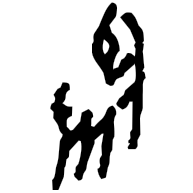 甲骨文 oracle bone · 商
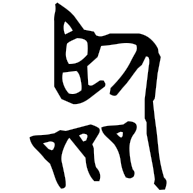 金文 bronze · 西周早期
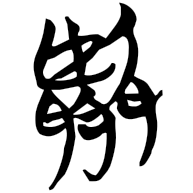 戰國文字 Warring States · 戰國.楚
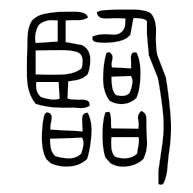 篆文 seal
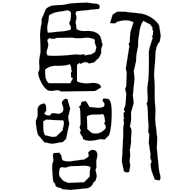 隸書 clerical · 秦
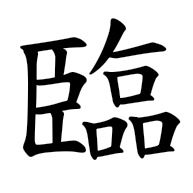 楷書 regular
Legge's note (1882)
Legge's title for the hexagram: .
XIX. In Appendix VI Lin is explained as meaning ‘great.’ The writer, having misunderstood the meaning of the previous Kû, subjoins—‘He who performs such services may become “ great.”’ But Lin denotes the approach of authority,—to inspect, to comfort, or to rule. When we look at the figure, we see two strong undivided lines advancing on the four weak lines above them, and thence follows the assurance that their action will be powerful and successful. That action must be governed by rectitude, however, and by caution grounded on the changing character of all conditions and events. The meaning of the concluding sentence is given in Appendix I as simply being—that, ‘the advancing power will decay in no long time.’ Lû Kăn-khî (Ming dynasty) says:—‘The sun (or the day) is the symbol of what is Yang; and the moon is the symbol of what is Yin. Eight is the number of the second of the four emblematic figures (the smaller Yin), and seven is the number of the third of them (the smaller Yang). Hence to indicate the period of the coming of what is Yin, we use the phrase, “the eighth month;” and to indicate the period of the coming of what is Yang, we use the phrase, “the seventh day.”’ The Khang-hsî editors say that this is the best explanation of the language of the Text that can be given:—‘The Yang numbers culminate in 9, the influence then receding and producing the 8 of the smaller Yin. The Yin numbers culminate in 6, and the next advance produces the 7 of the smaller Yang; so that 7 and 8 are the numbers indicating the first birth of what is Yin and what is Yang.’ ‘If we go to seek,’ they add, ‘any other explanation of the phraseology of the Text, and such expressions as “ 3 days,” “3 years,” “10 years,” &c., we make them unintelligible.’ Lin is the hexagram of the twelfth month. Line 1 is a strong line in its proper place. The danger is that its subject may be more strong than prudent, hence the caution in requiring firm correctness. Line 2, as strong, should be in an odd place; but this is more than counterbalanced by the central position, and its correlate in line 5. Line 3 is weak, and neither central, nor in its correct position. Hence its action will not be advantageous; but being at the top of the trigram Tui, which means being pleased, its subject is represented as ‘well pleased to advance.’ Anxious reflection will save him from error. Line 4, though weak, is in its proper place, and has for its correlate the strong 1. Hence its advance is ‘in the highest style.’ Line 5 is the position of the ruler. It is weak, but being central, and having for its correlate the strong and central 2, we have in it a symbol of authority distrustful of itself, and employing fit agents;— characteristic of the wise ruler. Line 6 is the last of the trigram Khwăn, the height therefore of docility. Line 2 is not its correlate, but it belongs to the Yin to seek for the Yang; and it is so emphatically in this case. Hence the characteristic and issue as assigned.
Sources
- Chinese text: 周易, 維基文庫, page (revision 2106146); the text is public domain, the site's edits CC BY-SA 4.0.
- English: James Legge, The Yî King, Sacred Books of the East vol. XVI, Oxford 1882 (public domain), where this hexagram is “Lin”.
- Glyph images: 小學堂 字形演變, Academia Sinica (CC0 1.0).
- Pinyin: Unihan (Unicode License v3) with this site's readings for the classical cases. English gloss, relations, the idiom glosses, the English of the chronicle passages and the plain reading: this site.