- The 64
- Hexagram 25
25 无妄 Without Pretence
震 Thunder below, 乾 Heaven above
Thunder moving under heaven: without pretence, the innocence of acting without calculation. The text says it gets through greatly with firmness, and that what is not correct meets harm and should not set out.
Tap a line of the figure to see where it leads when it changes. Cast for a question of your own. New here? What the I Ching is, coming from tarot.
This site's reading
卦辭 元亨,利貞: great, penetrating, firmness advantageous. 其匪正有眚: if not correct, there is harm; not advantageous to go anywhere. Innocence is not licence; it is acting rightly without looking for a return.
彖 The commentary: the firm comes from outside and becomes the master within; moving and strong, firm in the centre and answered; great success through correctness, heaven's mandate. Where would going without pretence go, if heaven's mandate does not help it?
大象 Thunder moving under heaven and every thing given its unpretending nature: the former kings, rich in accord with the season, nourished all things. Innocence here is the spring's own growth.
爻 The lines: without pretence, going is good; not ploughing for the harvest, not clearing for the third-year field, and yet advantageous to go; the innocent's calamity, an ox tied up, the traveller's gain and the townsman's loss; able to be firm, no blame; the innocent's illness, no medicine and there is joy; and at the top innocent, yet going brings harm, nothing advantageous. Innocence can still be struck by chance (line 3) and still be told to stop (line 6).
If your question is about
- A relationship
- Act without calculating the return (line 2); take no medicine for what will pass (line 5). Undeserved loss (line 3) is here too.
- Work
- Do the right thing without working the angles; the text favours it while it stays correct. If the move is not straight, it meets harm.
- A decision
- Yes if it is correct and uncalculated (line 1); no if you are forcing it (line 6). Innocence knows when to stop.
- No line changing
- Innocence as a state, moving under heaven. Nourish with the season; expect the odd undeserved loss and let it pass without medicine.
Written from the text above and checked against it by Lun (2026-10-24). It is a way of reading the hexagram, not a prediction.
The text, with Legge
Judgment 卦辭
无妄:元亨。利貞。其匪正有眚,不利有攸往。
Wû Wang indicates great progress and success, while there will be advantage in being firm and correct. If (its subject and his action) be not correct, he will fall into errors, and it will not be advantageous for him to move in any direction. (Legge, 1882)
Commentary on the Judgment 彖
无妄,剛自外來,而為主於內。動而健,剛中而應,大亨以正,天之命也。其匪正有眚,不利有攸往。无妄之往,何之矣? 天命不佑,行矣哉?
The Image 大象
天下雷行,物與无妄;先王以茂對時,育萬物。
The six lines
Line 1 初九
无妄,往吉。
The first line, undivided, shows its subject free from all insincerity. His advance will be accompanied with good fortune. (Legge, 1882)
The Image 小象
无妄之往,得志也。
Changing, this line leads to 12 否 Pǐ.
Line 2 六二
不耕穫,不菑畬,則利有攸往。
The second line, divided, shows one who reaps without having ploughed (that he might reap), and gathers the produce of his third year’s fields without having cultivated them the first year for that end. To such a one there will be advantage in whatever direction he may move. (Legge, 1882)
The Image 小象
不耕穫,未富也。
Changing, this line leads to 10 履 Lǚ.
Line 3 六三
无妄之災,或繫之牛,行人之得,邑人之災。
The third line, divided, shows calamity happening to one who is free from insincerity;—as in the case of an ox that has been tied up. A passer by finds it (and carries it off), while the people in the neighbourhood have the calamity (of being accused and apprehended). (Legge, 1882)
The Image 小象
行人得牛,邑人災也。
Changing, this line leads to 13 同人 Tóng Rén.
Line 4 九四
可貞,无咎。
The fourth line, undivided, shows (a case) in which, if its subject can remain firm and correct, there will be no error. (Legge, 1882)
The Image 小象
可貞无咎,固有之也。
Changing, this line leads to 42 益 Yì.
Line 5 九五
无妄之疾,勿藥有喜。
The fifth line, undivided, shows one who is free from insincerity, and yet has fallen ill. Let him not use medicine, and he will have occasion for joy (in his recovery). (Legge, 1882)
The Image 小象
无妄之藥,不可試也。
Changing, this line leads to 21 噬嗑 Shì Kè.
Line 6 上九
无妄,行有眚,无攸利。
The topmost line, undivided, shows its subject free from insincerity, yet sure to fall into error, if he take action. (His action) will not be advantageous in any way. (Legge, 1882)
The Image 小象
无妄之行,窮之災也。
Changing, this line leads to 17 隨 Suí.
Words that came from it
Phrases a billion people use today began as clauses of this hexagram.
- 無妄之災
- a disaster that comes without any fault. Undeserved misfortune; a phrase heard in any account of bad luck. From line 3: 无妄之災.
Related hexagrams
Where the name comes from
无
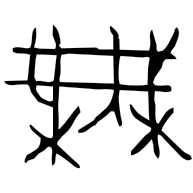 金文 bronze · 春秋中期
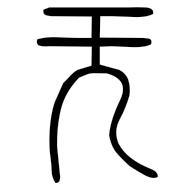 篆文 seal
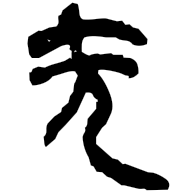 隸書 clerical · 秦
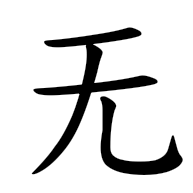 楷書 regular
妄
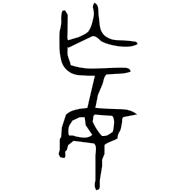 金文 bronze · 西周晚期
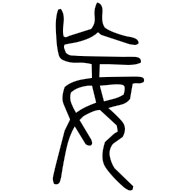 篆文 seal
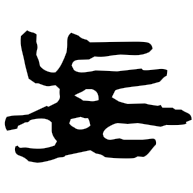 隸書 clerical · 西漢
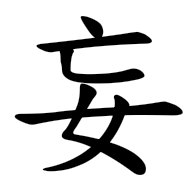 楷書 regular
Legge's note (1882)
Legge's title for the hexagram: freedom from insincerity.
XXV. Wang is the symbol of being reckless, and often of being insincere; Wû Wang is descriptive of a state of entire freedom from such a condition; its subject is one who is entirely simple and sincere. The quality is characteristic of the action of Heaven, and of the highest style of humanity. In this hexagram we have an essay on this noble attribute. An absolute rectitude is essential to it. The nearer one comes to the ideal of the quality, the more powerful will be his influence, the greater his success. But let him see to it that he never swerve from being correct. The first line is strong; at the commencement of the inner trigram denoting movement, the action of its subject will very much characterise all the action set forth, and will itself be fortunate. Line 2 is weak, central, and in its correct place. The quality may be predicated of it in its highest degree. There is an entire freedom in its subject from selfish or mercenary motive. He is good simply for goodness’ sake. And things are so constituted that his action will be successful. But calamity may also sometimes befal the best, and where there is this freedom from insincerity; and line 3 being weak, and in the place of an even line, lays its subject open to this misfortune. ‘The people of the neighbourhood’ are of course entirely innocent. Line 4 is the lowest in the trigram of strength, and 1 is not a proper correlate, nor is the fourth the place for a strong line. Hence the paragraph must be understood as a caution. Line 5 is strong, in the central place of honour, and has its proper correlate in 2. Hence its subject must possess the quality of the hexagram in perfection. And yet he shall be sick or in distress. But he need not be anxious. Without his efforts a way of escape for him will be opened. Line 6 is at the top of the hexagram, and comes into the field when the action has run its course. He should be still, and not initiate any fresh movement.
Sources
- Chinese text: 周易, 維基文庫, page (revision 10645038); the text is public domain, the site's edits CC BY-SA 4.0.
- English: James Legge, The Yî King, Sacred Books of the East vol. XVI, Oxford 1882 (public domain), where this hexagram is “Wû Wang”.
- Glyph images: 小學堂 字形演變, Academia Sinica (CC0 1.0).
- Pinyin: Unihan (Unicode License v3) with this site's readings for the classical cases. English gloss, relations, the idiom glosses, the English of the chronicle passages and the plain reading: this site.