- The 64
- Hexagram 16
16 豫 Gladness
坤 Earth below, 震 Thunder above
Thunder bursting out of the earth: gladness, readiness, the enthusiasm that moves many. The text says it is the time to set up lords and move armies; the lines warn what gladness becomes when it is only pleasure.
Tap a line of the figure to see where it leads when it changes. Cast for a question of your own. New here? What the I Ching is, coming from tarot.
This site's reading
卦辭 利建侯行師: advantageous to establish lords and set armies moving. Gladness here is a force that gets people to move together, and the Judgment points it at work.
彖 The commentary: the firm line answered and its will carried out, moving in accord, that is gladness. Heaven and earth move so, and the sun and moon do not err and the seasons do not fail; the sage moves so, and punishments are clear and the people submit. "Great is the meaning of this time" (豫之時義大矣哉).
大象 Thunder comes out of the earth and rouses: the former kings made music to honour virtue, offering it to the Highest and to the ancestors. Gladness is given form as music.
爻 The lines: gladness proclaimed, evil; firm as a rock, not waiting a whole day, good; gladness that looks up for favour, regret, delay and more regret; gladness that comes from oneself, great gain, no doubting, friends gather like hair in a clasp; a lasting illness that does not kill; and at the top gladness in the dark, which can still change, no blame. The second line is the sober one, the fourth the source; the first and third are gladness as show and as craving.
If your question is about
- A relationship
- Shared joy that moves both (line 4) against joy proclaimed (line 1) or joy waiting on favour (line 3). Be the rock of line 2.
- Work
- A time to mobilise: set up the structure and move people with enthusiasm (the Judgment). Keep the discipline of the rock.
- A decision
- Go, if the gladness comes from within (line 4) and you see the thing before it arrives (line 2). Not for applause.
- No line changing
- Enthusiasm as a state. Give it a form, as the kings gave it music; unshaped, it drifts into the dark gladness of the top line.
Written from the text above and checked against it by Lun (2026-10-24). It is a way of reading the hexagram, not a prediction.
The text, with Legge
Judgment 卦辭
豫:利建侯行師。
Yü indicates that, (in the state which it implies), feudal princes may be set up, and the hosts put in motion, with advantage. (Legge, 1882)
Commentary on the Judgment 彖
豫,剛應而志行,順以動,豫。豫,順以動,故天地如之,而況建侯行師乎?天地以順動,故日月不過,而四時不忒;聖人以順動,則刑罰清而民服。豫之時義大矣哉!
The Image 大象
雷出地奮,豫。先王以作樂崇德,殷薦之上帝,以配祖考。
The six lines
Line 1 初六
鳴豫,凶。
The first line, divided, shows its subject proclaiming his pleasure and satisfaction. There will be evil. (Legge, 1882)
The Image 小象
初六鳴豫,志窮凶也。
Changing, this line leads to 51 震 Zhèn.
Line 2 六二
介于石,不終日,貞吉。
The second line, divided, shows one who is firm as a rock. (He sees a thing) without waiting till it has come to pass; with his firm correctness there will be good fortune. (Legge, 1882)
The Image 小象
不終日,貞吉;以中正也。
Changing, this line leads to 40 解 Xiè.
Line 3 六三
盱豫,悔。遲有悔。
The third line, divided, shows one looking up (for favours), while he indulges the feeling of pleasure and satisfaction. If he would understand!—If he be late in doing so, there will indeed be occasion for repentance. (Legge, 1882)
The Image 小象
盱豫有悔,位不當也。
Changing, this line leads to 62 小過 Xiǎo Guò.
Line 4 九四
由豫,大有得。勿疑。朋盍戠。
The fourth line, undivided, shows him from whom the harmony and satisfaction come. Great is the success which he obtains. Let him not allow suspicions to enter his mind, and thus friends will gather around him. (Legge, 1882)
The Image 小象
由豫,大有得;志大行也。
Changing, this line leads to 2 坤 Kūn.
Line 5 六五
貞疾,恆不死。
The fifth line, divided, shows one with a chronic complaint, but who lives on without dying. (Legge, 1882)
The Image 小象
六五貞疾,乘剛也。恆不死,中未亡也。
Changing, this line leads to 45 萃 Cuì.
Line 6 上六
冥豫,成有渝,无咎。
The topmost line, divided, shows its subject with darkened mind devoted to the pleasure and satisfaction (of the time); but if he change his course even when (it may be considered as) completed, there will be no error. (Legge, 1882)
The Image 小象
冥豫在上,何可長也。
Changing, this line leads to 35 晉 Jìn.
In history
The 左傳 and 國語, the chronicles of the sixth to fifth centuries BC, record real casts of the Changes and what came of them. One of them gave this hexagram.
637 BC: 公子重耳, the future 晉文公, in exile at the court of 秦
Asked: Shall I have the state of 晉? The stalks gave 3 屯 turning to 16 豫.
不有晉國,以輔王室,安能建侯?我命筮曰:『尚有晉國』,筮告我曰:『利建侯』,得國之務也,吉孰大焉!The cast gave 屯 as the inner result and 豫 as the outer, all 八. The court diviners called it closed and blocked, nothing moving. 司空季子 disagreed: in the Changes both hexagrams say 'favourable to establish a lord'. He had asked for the state and the stalks answered with a lord's establishment: thunder and chariot, water and crowd.
秦 escorted 重耳 home in 636 BC and he took the throne as 晉文公. Six years later he beat 楚 at 城濮 and became hegemon.
國語 晉語四, 維基文庫 (revision 1998799). 貞屯悔豫皆八 is an old notation: 屯 as the first (貞) figure and 豫 as the second (悔), with the unmoved yin lines marked 八. Lines 1, 4 and 5 differ between the two figures, so no single moving line is given. The 國語 page carries 韋昭's commentary inline; the quote is from the main text.
The chronicles' diviners read from oracle texts of their own time; where their words match our clause text the note says so, and where they do not, it says that. None of this is a claim that the text foretold the event.
Related hexagrams
Where the name comes from
豫
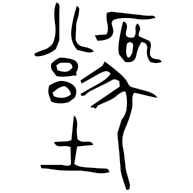 金文 bronze · 春秋晚期
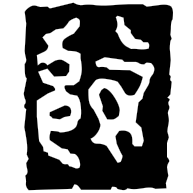 戰國文字 Warring States · 戰國.齊
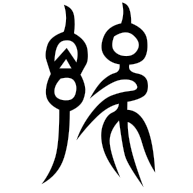 篆文 seal
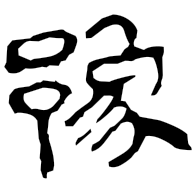 隸書 clerical · 西漢
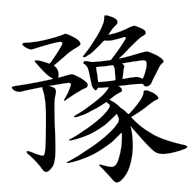 楷書 regular
Legge's note (1882)
Legge's title for the hexagram: harmony and satisfaction.
XVI. The Yü hexagram denoted to king Wăn a condition of harmony and happy contentment throughout the kingdom, when the people rejoiced in and readily obeyed their sovereign. At such a time his appointments and any military undertakings would be hailed and supported. The fourth line, undivided, is the lord of the figure, and being close to the fifth or place of dignity, is to be looked on as the minister or chief officer of the ruler. The ruler gives to him his confidence; and all represented by the other lines yield their obedience. Line 1 is weak, and has for its correlate the strong 4. Its subject may well enjoy the happiness of the time. But he cannot contain himself, and proclaims, or boasts of, his satisfaction;— which is evil. Line 2, though weak, is in its correct position, the centre, moreover, of the lower trigram. Quietly and firmly its subject is able to abide in his place, and exercise a far-seeing discrimination. All is indicative of good fortune. Line 3 is weak, and in an odd place. Immediately below line 4, its subject keeps looking up to the lord of the figure, and depends on him, thinking of doing nothing, but how to enjoy himself. The consequence will be as described, unless he speedily change. The strong subject of line 4 is the agent to whom the happy condition is owing; and it is only necessary to caution him to maintain his confidence in himself and his purpose, and his adherents and success will continue. Line 5 is in the ruler’s place; but it is weak, and he is in danger of being carried away by the lust of pleasure. Moreover, proximity to the powerful minister represented by 4 is a source of danger. Hence he is represented as suffering from a chronic complaint, but nevertheless he does not die. See Appendix II on the line. Line 6, at the very top or end of the hexagram, is weak, and its subject is all but lost. Still even for him there is a chance of safety, if he will but change.
Sources
- Chinese text: 周易, 維基文庫, page (revision 10645735); the text is public domain, the site's edits CC BY-SA 4.0.
- English: James Legge, The Yî King, Sacred Books of the East vol. XVI, Oxford 1882 (public domain), where this hexagram is “Yü”.
- Glyph images: 小學堂 字形演變, Academia Sinica (CC0 1.0).
- Pinyin: Unihan (Unicode License v3) with this site's readings for the classical cases. English gloss, relations, the idiom glosses, the English of the chronicle passages and the plain reading: this site.