- The 64
- Hexagram 55
55 豐 Abundance
離 Fire below, 震 Thunder above
Thunder and lightning at once: abundance, fullness at its height. The text says the king arrives at it and need not worry, and tells him to be like the sun at noon, which the commentary says is the moment it begins to set.
Tap a line of the figure to see where it leads when it changes. Cast for a question of your own. New here? What the I Ching is, coming from tarot.
This site's reading
卦辭 亨。王假之,勿憂,宜日中: it gets through; the king arrives at it; do not worry; be fit for the sun at noon. Abundance is a height to be occupied without anxiety.
彖 The commentary: 豐 is greatness; brightness with movement, hence abundance. The king arrives at it, honouring greatness; do not worry, be as the noon sun, fit to shine on the world. The sun at noon declines, the full moon wanes; heaven and earth fill and empty with the time, and how much more people.
大象 Thunder and lightning both come: the noble person decides lawsuits and carries out punishments. Full light is for judging clearly.
爻 The lines: meeting one's matching lord, though equal, no blame, going is honoured; a screen so thick the Dipper is seen at noon, going brings doubt, sincerity breaks through, good; a banner so thick the small stars are seen, the right arm broken, no blame; the screen again, meeting the lord of one's own kind, good; brilliance comes, celebration and praise, good; and at the top the house enlarged, the family screened, no one at the door, three years unseen, evil. Abundance screens its own light; the top line is the great house with no one in it.
If your question is about
- A relationship
- Fullness, and the screen that fullness puts up (lines 2 to 4); sincerity breaks through it. The enlarged, empty house (line 6) is the warning.
- Work
- Noon: shine on everything and decide clearly (the Image). Do not worry about the decline; use the height while it is yours.
- A decision
- Go, in the full light; the text honours it (line 1). Know that noon is also the turn.
- No line changing
- Abundance that holds: the sun kept at noon. Keep the screens thin and the house peopled; fullness empties with the time.
Written from the text above and checked against it by Lun (2026-10-24). It is a way of reading the hexagram, not a prediction.
The text, with Legge
Judgment 卦辭
豐:亨。王假之,勿憂,宜日中。
Făng intimates progress and development. When a king has reached the point (which the name denotes) there is no occasion to be anxious (through fear of a change). Let him be as the sun at noon. (Legge, 1882)
Commentary on the Judgment 彖
豐,大也。明以動,故豐。王假之,尚大也。勿憂宜日中,宜照天下也。日中則昃,月盈則食,天地盈虛,與時消息,而況于人乎?況于鬼神乎?
The Image 大象
雷電皆至,豐;君子以折獄致刑。
The six lines
Line 1 初九
遇其配主,雖旬无咎,往有尚。
The first line, undivided, shows its subject meeting with his mate. Though they are both of the same character, there will be no error. Advance will call forth approval. (Legge, 1882)
The Image 小象
雖旬无咎,過旬災也。
Changing, this line leads to 62 小過 Xiǎo Guò.
Line 2 六二
豐其蔀,日中見斗,往得疑疾,有孚發若,吉。
The second line, divided, shows its subject surrounded by screens so large and thick that at midday he can see from them the constellation of the Bushel. If he go (and try to enlighten his ruler who is thus emblemed), he will make himself to be viewed with suspicion and dislike. Let him cherish his feeling of sincere devotion that he may thereby move (his ruler’s mind), and there will be good fortune. (Legge, 1882)
The Image 小象
有孚發若,信以發志也。
Changing, this line leads to 34 大壯 Dà Zhuàng.
Line 3 九三
豐其沛,日中見沬,折其右肱,无咎。
The third line, undivided, shows its subject with an (additional) screen of a large and thick banner, through which at midday he can see (the small) Mei star. (In the darkness) he breaks his right arm; but there will be no error. (Legge, 1882)
The Image 小象
豐其沛,不可大事也。折其右肱,終不可用也。
Changing, this line leads to 51 震 Zhèn.
Line 4 九四
豐其蔀,日中見斗,遇其夷主,吉。
The fourth line, undivided, shows its subject in a tent so large and thick that at midday he can see from it the constellation of the Bushel. But he meets with the subject of the (first) line, undivided like himself. There will be good fortune. (Legge, 1882)
The Image 小象
豐其蔀,位不當也。日中見斗,幽不明也。遇其夷主,吉;行也。
Changing, this line leads to 36 明夷 Míng Yí.
Line 5 六五
來章,有慶譽,吉。
The fifth line, divided, shows its subject bringing around him the men of brilliant ability. There will be occasion for congratulation and praise. There will be good fortune. (Legge, 1882)
The Image 小象
六五之吉,有慶也。
Changing, this line leads to 49 革 Gé.
Line 6 上六
豐其屋,蔀其家,窺其戶,闃其无人,三歲不觌,凶。
The topmost line, divided, shows its subject with his house made large, but only serving as a screen to his household. When he looks at his door, it is still, and there is nobody about it. For three years no one is to be seen. There will be evil. (Legge, 1882)
The Image 小象
豐其屋,天際翔也。窺其戶,闃其无人,自藏也。
Changing, this line leads to 30 離 Lí.
Words that came from it
Phrases a billion people use today began as clauses of this hexagram.
- 日中則昃
- the sun at noon begins to set. Everything at its height begins to decline; the commentary's line is quoted whole. From the commentary on the Judgment 彖: 日中則昃.
Related hexagrams
Where the name comes from
豐
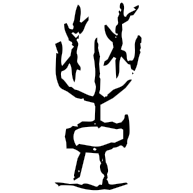 甲骨文 oracle bone · 商
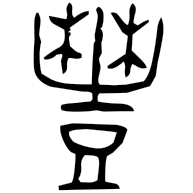 金文 bronze · 西周中期
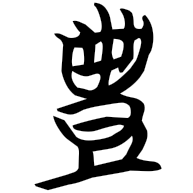 戰國文字 Warring States · 戰國.楚
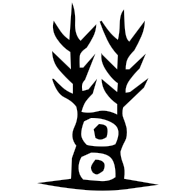 篆文 seal
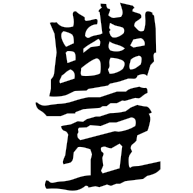 隸書 clerical · 西漢
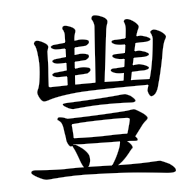 楷書 regular
Legge's note (1882)
Legge's title for the hexagram: large and abundant.
LV. The character Făng is the symbol of being large and abundant, and, as the name of this hexagram, denotes a condition of abundant prosperity. In the changes of human affairs a condition of prosperity has often given place to one of an opposite character. The lesson of the hexagram is to show to rulers how they may preserve the prosperity of their state and people. The component trigrams have the attributes of intelligence and of motive force, and the second is under the direction of the first. A ruler with these attributes is not likely to fail in maintaining his crown and prosperity, and it may well be said that the figure intimates progress and development. The king is told not to be anxious, but to study how he may always be like the sun in his meridian height, cheering and enlightening all. The explanation of the Thwan is thus natural and easy. It will be found that a change is introduced in explaining the symbolism of the lines, which it is as well to point out here. Thus far we have found that to constitute a proper correlation between two lines, one of them must be whole, and the other divided. Here two undivided lines make a correlation. The law, evidently made for the occasion, goes far to upset altogether the doctrine of correlated lines. I have been surprised that the rules about the lines stated in the Introduction, pp. 15,16, have held good so often. There have been various deviations from them, but none so gross as that in this hexagram. Line 1 is strong, and in an odd place. Its correlate is 4, which would in other figures be deemed unfortunate. But here even the Text calls 4 (for the reference must be to it) the mate of 1, and makes their belonging to different categories of no account. The lesson taught is that mutual helpfulness is the great instrument for the maintenance of prosperity. The subject of line 1 is encouraged to go forward. Line 2 is divided, and in its proper place. Occupying the centre, of the trigram of brightness, the intelligence of it should be concentrated in its subject; but his correlate is the weak 5, weak and in an improper place, so that he becomes the benighted ruler, and darkness is shed from him down on 2, which is strangely symbolised. The subject of 2 therefore, if he advance, will not be acceptable to his ruler, and will not be employed. The only way in which he can be useful by developing the light that is in him is pointed out in the conclusion. The constellation of the Bushel corresponds to our Ursa Major, or perhaps part of Sagittarius. Line 3 is strong, in its proper place. It is the last line moreover of the trigram of Brightness. All these conditions are favourable to the employment of its subject; but its correlate is the weak 6, which is at the extremity of the trigram of movement. There is no more power therefore in 6, and the subject of 3 has no one to co-operate with him. His symbolism and auspice are worse than those of 2; but his own proper goodness and capacity will save him from error. Mei is a small star in or near the Bushel. The symbolism of line 4 is the same as that of 2, till we come to the last sentence. Then there is the strange correlation of the two strong lines in 4 and 1; and the issue is good. The subject of line 5 is in the ruler’s place, himself weak, but ‘the lord’ of the trigram of movement. He can do little unhelped, but if he can bring into the work and employ in his service the talents of 1, 3, and 4, and even of 2, his correlate, the results will be admirable. Nothing consolidates the prosperity of a country so much as the co-operation of the ruler and able ministers. All the conditions of line 6 are unfavourable, and its subject is left to himself without any helpers. He is isolated for long, and undone. The issue is only evil.
Sources
- Chinese text: 周易, 維基文庫, page (revision 10645290); the text is public domain, the site's edits CC BY-SA 4.0.
- English: James Legge, The Yî King, Sacred Books of the East vol. XVI, Oxford 1882 (public domain), where this hexagram is “Făng”.
- Glyph images: 小學堂 字形演變, Academia Sinica (CC0 1.0).
- Pinyin: Unihan (Unicode License v3) with this site's readings for the classical cases. English gloss, relations, the idiom glosses, the English of the chronicle passages and the plain reading: this site.