- The 64
- Hexagram 36
36 明夷 Light Wounded
離 Fire below, 坤 Earth above
The sun gone down into the earth: light wounded, brightness in a dark time. The text gives one counsel, 利艱貞, firmness is advantageous in hardship, and names the two men who lived it, King Wen and the Count of Ji.
Tap a line of the figure to see where it leads when it changes. Cast for a question of your own. New here? What the I Ching is, coming from tarot.
This site's reading
卦辭 利艱貞: advantageous to be firm in difficulty. Nothing more. The whole hexagram is how to keep the light when the time is dark.
彖 The commentary: brightness enters the earth, the light wounded. Cultured and bright within, yielding and compliant without, and so meeting great difficulty: King Wen did this. Firm in hardship, dimming one's own brightness, inwardly troubled yet able to keep the will correct: the Count of Ji did this.
大象 Brightness entering the earth: the noble person in governing the many uses obscurity and is bright. Hide the light to keep it.
爻 The lines: the wounded light flying with drooping wings, the noble person on the road three days without eating, going somewhere and the host has words; wounded in the left thigh, saved by a strong horse, good; the wounded light hunting in the south, taking the great chief, but do not be hasty in firmness; entering the left belly and getting the heart of the wounded light, out through the gate and court; the Count of Ji's wounded light, firmness advantageous; and at the top no light but darkness, first climbing to the sky, then going into the earth. The fifth line is the model: a prince who feigned madness to keep his mind.
If your question is about
- A relationship
- A dark time; keep your light inside and your bearing mild (the commentary). The Count of Ji kept his will correct by seeming dim.
- Work
- Hide the brightness to keep it (the Image); do not be hasty even when you win (line 3). Leave by the gate once you understand.
- A decision
- Hold firm in the difficulty; not a time to shine or to push. The top line rose first and fell.
- No line changing
- Darkness that stays. Firm in hardship is the only counsel; it was enough for King Wen.
Written from the text above and checked against it by Lun (2026-10-24). It is a way of reading the hexagram, not a prediction.
The text, with Legge
Judgment 卦辭
明夷:利艱貞。
Ming Î indicates that (in the circumstances which it denotes) it will be advantageous to realise the difficulty (of the position), and maintain firm correctness. (Legge, 1882)
Commentary on the Judgment 彖
明入地中,明夷。內文明而外柔順,以蒙大難,文王以之。利艱貞,晦其明也,內難而能正其志,箕子以之。
The Image 大象
明入地中,明夷;君子以蒞眾,用晦而明。
The six lines
Line 1 初九
明夷于飛,垂其翼。君子于行,三日不食,有攸往,主人有言。
The first line, undivided, shows its subject, (in the condition indicated by) Ming Î, flying, but with drooping wings. When the superior man (is revolving) his going away, he may be for three days without eating. Wherever he goes, the people there may speak (derisively of him). (Legge, 1882)
The Image 小象
君子于行,義不食也。
Changing, this line leads to 15 謙 Qiān.
Line 2 六二
明夷,夷于左股,用拯馬壯,吉。
The second line, divided, shows its subject, (in the condition indicated by) Ming Î, wounded in the left thigh. He saves himself by the strength of a (swift) horse; and is fortunate. (Legge, 1882)
The Image 小象
六二之吉,順以則也。
Changing, this line leads to 11 泰 Tài.
Line 3 九三
明夷于南狩,得其大首,不可疾貞。
The third line, undivided, shows its subject, (in the condition indicated by) Ming Î, hunting in the south, and taking the great chief (of the darkness). He should not be eager to make (all) correct (at once). (Legge, 1882)
The Image 小象
南狩之志,乃大得也。
Changing, this line leads to 24 復 Fù.
Line 4 六四
入于左腹,獲明夷之心,于出門庭。
The fourth line, divided, shows its subject (just) entered into the left side of the belly (of the dark land). (But) he is able to carry out the mind appropriate (in the condition indicated by) Ming Î, quitting the gate and courtyard (of the lord of darkness). (Legge, 1882)
The Image 小象
入于左腹,獲心意也。
Changing, this line leads to 55 豐 Fēng.
Line 5 六五
箕子之明夷,利貞。
The fifth line, divided, shows how the count of Kî fulfilled the condition indicated by Ming Î. It will be advantageous to be firm and correct. (Legge, 1882)
The Image 小象
箕子之貞,明不可息也。
Changing, this line leads to 63 既濟 Jì Jì.
Line 6 上六
不明晦,初登于天,後入于地。
The sixth line, divided, shows the case where there is no light, but (only) obscurity. (Its subject) had at first ascended to (the top of) the sky; his future shall be to go into the earth. (Legge, 1882)
The Image 小象
初登于天,照四國也。後入于地,失則也。
Changing, this line leads to 22 賁 Bì.
In history
The 左傳 and 國語, the chronicles of the sixth to fifth centuries BC, record real casts of the Changes and what came of them. One of them gave this hexagram.
537 BC: 莊叔 (叔孫得臣), at the birth of his son 叔孫豹 (穆子)
Asked: What is this son's fate? The stalks gave 36 明夷 with line 1 changing, to 15 謙.
是將行.而歸為子祀.以讒人入.其名曰牛.卒以餒死.卜楚丘 read the first line of 明夷, the wounded bird flying with drooping wings and the traveller who eats nothing for three days: the boy would go into exile, return to head the family's sacrifices, bring in a slanderer named 牛, and in the end die of hunger. Fire below the mountain burns it, and burnt words are slander.
叔孫豹 fled to 齊, came back to lead the 叔孫 house, and fathered a son there named 豎牛. In 538 BC 豎牛 isolated the sick old man and starved him to death.
左傳 昭公五年, 維基文庫 (revision 10445713). Told in retrospect, after 叔孫豹's death; the year is that of the passage, the cast was made decades earlier. The reading quotes the received line text of 明夷 初九.
The chronicles' diviners read from oracle texts of their own time; where their words match our clause text the note says so, and where they do not, it says that. None of this is a claim that the text foretold the event.
Related hexagrams
Where the name comes from
明
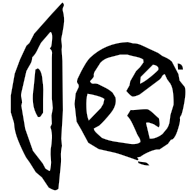 甲骨文 oracle bone · 商
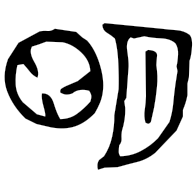 金文 bronze · 西周早期
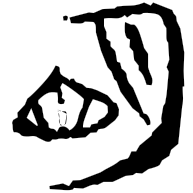 戰國文字 Warring States · 春秋晚期或戰國早期.晉
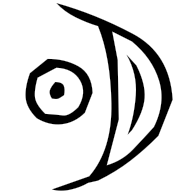 篆文 seal
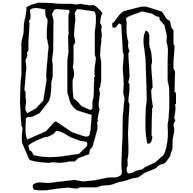 隸書 clerical · 秦
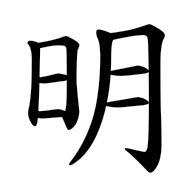 楷書 regular
夷
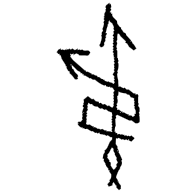 甲骨文 oracle bone · 商
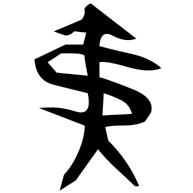 金文 bronze · 西周晚期
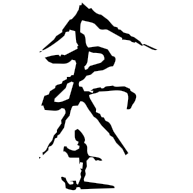 戰國文字 Warring States · 春秋晚期或戰國早期.晉
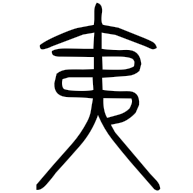 篆文 seal
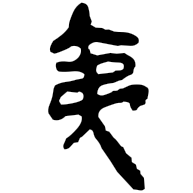 隸書 clerical · 西漢
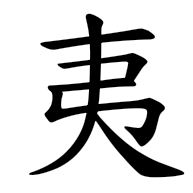 楷書 regular
Legge's note (1882)
Legge's title for the hexagram: Intelligence Wounded.
XXXVI. In this hexagram we have the representation of a good and intelligent minister or officer going forward in the service of his country, notwithstanding the occupancy of the throne by a weak and unsympathising sovereign. Hence comes its name of Ming Î, or ‘Intelligence Wounded,’ that is, injured and repressed. The treatment of the subject shows how such an officer will conduct himself, and maintain his purpose. The symbolism of the figure is treated of in the same way in the first and second Appendixes. Appendix VI merely says that the advance set forth in 35 is sure to meet with wounding, and hence Ȝin is followed by Ming Î. Line 1 is strong, and in its right place;—its subject should be going forward. But the general signification of the hexagram supposes him to be wounded. The wound, however, being received at the very commencement of its action, is but slight. And hence comes the emblem of a bird hurt so as to be obliged to droop its wings. The subject then appears directly as ‘the superior man.’ He sees it to be his course to desist from the struggle for a time, and is so rapt in the thought that he can fast for three days and not think of it. When he does withdraw, opposition follows him; but it is implied that he holds on to his own good purpose. Line 2 is weak, but also in its right place, and central; giving us the idea of an officer, obedient to duty and the right. His wound in the left thigh may impede his movements, but does not disable him. He finds means to save himself, and maintains his good purpose. Line 3, strong and in a strong place, is the topmost line of the lower trigram. It responds also to line 6, in which the idea of the sovereign, emblemed by the upper trigram, is concentrated. The lower trigram is the emblem of light or brightness, the idea of which again is expressed by the south, to which we turn when we look at the sun in its meridian height. Hence the subject of the line becomes a hunter pursuing his game, and successfully. The good officer will be successful in his struggle; but let him not be over eager to put all things right at once. Line 4 is weak, but in its right place. Kû Hsî says he does not understand the symbolism, as given in the Text. The translation indicates the view of it commonly accepted. The subject of the line evidently escapes from his position of danger with little damage. Line 5 should be the place of the ruler or sovereign in the hexagram; but 6 is assigned as that place in Ming Î. The officer occupying 5, the centre of the upper trigram, and near to the sovereign, has his ideal in the count of Kî, whose action appears in the Shû, III, pp. 123,127,128. He is a historical personage. Line 6 sets forth the fate of the ruler, who opposes himself to the officer who would do him good and intelligent service. Instead of becoming as the sun, enlightening all from the height of the sky, he is as the sun hidden below the earth. I can well believe that the writer had the last king of Shang in his mind.
Sources
- Chinese text: 周易, 維基文庫, page (revision 10644507); the text is public domain, the site's edits CC BY-SA 4.0.
- English: James Legge, The Yî King, Sacred Books of the East vol. XVI, Oxford 1882 (public domain), where this hexagram is “Ming Δ.
- Glyph images: 小學堂 字形演變, Academia Sinica (CC0 1.0).
- Pinyin: Unihan (Unicode License v3) with this site's readings for the classical cases. English gloss, relations, the idiom glosses, the English of the chronicle passages and the plain reading: this site.