- The 64
- Hexagram 5
5 需 Waiting
乾 Heaven below, 坎 Water above
Strength below, danger ahead: the right kind of waiting. The text says that with sincerity this shines and gets through, that firmness brings good fortune, and that the great stream can be crossed.
Tap a line of the figure to see where it leads when it changes. Cast for a question of your own. New here? What the I Ching is, coming from tarot.
This site's reading
卦辭 需 is to wait, with 有孚, sincerity, holding the figure together: 光亨, bright and penetrating; firm, good; advantageous to cross the great stream. Waiting here is not hesitation; it is strength that does not throw itself into the water.
彖 The commentary: 需 means to pause (須), because danger is in front; firm and strong and not falling in, its meaning is not to be exhausted. The fifth line sits in heaven's place, central and correct; crossing the stream is going on to achievement.
大象 Clouds rising to the sky: the noble person eats, drinks, feasts and is at ease. The rain will come; the Image's counsel for a wait is to live well inside it.
爻 The lines wait in six places: on the open border, where constancy is wanted; on the sand, with some talk but good at the end; in the mud, which invites the robber; in blood, and out of the pit; at wine and food, firm and good; and at the top in the pit itself, where three unexpected guests arrive and respecting them ends well. The line you hold says how close to the water you stand.
If your question is about
- A relationship
- Wait with ease, not with anxiety (the fifth line's wine and food). Standing in the mud, pressing at the edge, is what draws harm.
- Work
- Do not cross yet; the strength is real and so is the danger. Keep constant on the border and the crossing comes with achievement.
- A decision
- Not now, and not never. Sincere waiting shines; crossing comes when the fifth line's firmness is yours.
- No line changing
- A wait that holds. Feed yourself inside it; the text's one instruction for waiting is to be at ease.
Written from the text above and checked against it by Lun (2026-10-24). It is a way of reading the hexagram, not a prediction.
The text, with Legge
Judgment 卦辭
需:有孚,光亨。貞吉,利涉大川。
Hsü intimates that, with the sincerity which is declared in it, there will be brilliant success. With firmness there will be good fortune; and it will be advantageous to cross the great stream. (Legge, 1882)
Commentary on the Judgment 彖
需,須也,險在前也;剛健而不陷,其義不困窮矣。需,有孚,光亨,貞吉,位乎天位,以正中也。利涉大川,往有功也。
The Image 大象
雲上於天,需;君子以飲食宴樂。
The six lines
Line 1 初九
需于郊,利用恆,无咎。
The first line, undivided, shows its subject waiting in the distant border. It will be well for him constantly to maintain (the purpose thus shown), in which case there will be no error. (Legge, 1882)
The Image 小象
需于郊,不犯難行也。利用恆,无咎,未失常也。
Changing, this line leads to 48 井 Jǐng.
Line 2 九二
需于沙,小有言,終吉。
The second line, undivided, shows its subject waiting on the sand (of the mountain stream). He will (suffer) the small (injury of) being spoken (against), but in the end there will be good fortune. (Legge, 1882)
The Image 小象
需于沙,衍在中也。雖小有言,以吉終也。
Changing, this line leads to 63 既濟 Jì Jì.
Line 3 九三
需于泥,致寇至。
The third line, undivided, shows its subject in the mud (close by the stream). He thereby invites the approach of injury. (Legge, 1882)
The Image 小象
需于泥,災在外也。自我致寇,敬慎不敗也。
Changing, this line leads to 60 節 Jié.
Line 4 六四
需于血,出自穴。
The fourth line, divided, shows its subject waiting in (the place of) blood. But he will get out of the cavern. (Legge, 1882)
The Image 小象
需于血,順以聽也。
Changing, this line leads to 43 夬 Guài.
Line 5 九五
需于酒食,貞吉。
The fifth line, undivided, shows its subject waiting amidst the appliances of a feast. Through his firmness and correctness there will be good fortune. (Legge, 1882)
The Image 小象
酒食,貞吉,以中正也。
Changing, this line leads to 11 泰 Tài.
Line 6 上六
入于穴,有不速之客三人來,敬之終吉。
The topmost line, divided, shows its subject entered into the cavern. (But) there are three guests coming, without being urged, (to his help). If he receive them respectfully, there will be good fortune in the end. (Legge, 1882)
The Image 小象
不速之客來,敬之終吉。雖不當位,未大失也。
Changing, this line leads to 9 小畜 Xiǎo Chù.
Words that came from it
Phrases a billion people use today began as clauses of this hexagram.
- 不速之客
- guests who were not invited. The everyday phrase for an uninvited visitor comes straight from this line. From line 6: 不速之客.
In history
The 左傳 and 國語, the chronicles of the sixth to fifth centuries BC, record real casts of the Changes and what came of them. One of them gave this hexagram.
486 BC: 趙鞅 of 晉, through 陽虎, on marching to rescue 鄭 from 宋
Asked: Should 晉 go to the aid of 鄭? The stalks gave 11 泰 with line 5 changing, to 5 需.
宋方吉不可與也.微子啟.帝乙之.元子也.宋.鄭.甥舅也.祉.祿也.若帝乙之元子.歸妹而有吉祿.我安得吉焉.Three turtle readings had already warned against saving 鄭. 陽虎 then cast with the Changes and read the fifth line of 泰, '帝乙 gives his daughter in marriage, with blessing and great fortune'. 宋 descends from 帝乙's eldest son 微子, and 宋 and 鄭 are kin by marriage; if the blessing is 宋's, how can it be ours?
趙鞅 called off the campaign. 晉 did not march against 宋; the next year 趙鞅 took his army against 齊 instead.
左傳 哀公九年, 維基文庫 (revision 7908334). The line text 帝乙歸妹 is in the received 泰 六五. The page's punctuation splits 帝乙之.元子也.
The chronicles' diviners read from oracle texts of their own time; where their words match our clause text the note says so, and where they do not, it says that. None of this is a claim that the text foretold the event.
Related hexagrams
Where the name comes from
需
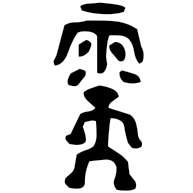 金文 bronze · 西周早期
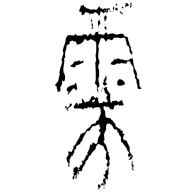 戰國文字 Warring States · 戰國.晉
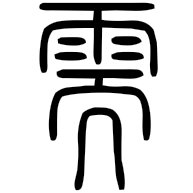 篆文 seal
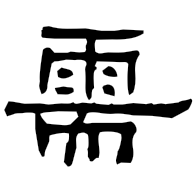 隸書 clerical · 東漢
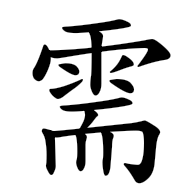 楷書 regular
Legge's note (1882)
Legge's title for the hexagram: waiting.
V. Hsü means waiting. Strength confronted by peril might be expected to advance boldly and at once to struggle with it; but it takes the wiser plan of waiting till success is sure. This is the lesson of the hexagram. That ‘sincerity is declared in it’ is proved from the fifth line in the position of honour and authority, central, itself undivided and in an odd place. In such a case, nothing but firm correctness is necessary to great success. ‘Going through a great stream,’ an expression frequent in the Yî, may mean undertaking hazardous enterprises, or encountering great difficulties, without any special reference; but more natural is it to understand by ‘the great stream’ the Yellow river, which the lords of Kâu must cross in a revolutionary movement against the dynasty of Yin and its tyrant. The passage of it by king Wû, the son of Wăn in B.C. 1122, was certainly one of the greatest deeds in the history of China. It was preceded also by long ‘waiting,’ till the time of assured success came. ‘The border’ under line 1 means the frontier territory of the state. There seems no necessity for such a symbolism. ‘The sand’ and ‘the mud’ are appropriate with reference to the watery defile; but it is different with ‘the border.’ The subject of the line appears at work in his distant fields, not thinking of anything but his daily work; and he is advised to abide in that state and mind. ‘The sand’ of paragraph 2 suggests a nearer approach to the defile, but its subject is still self-restrained and waiting. I do not see what suggests the idea of his suffering from ‘the strife of tongues.’ In paragraph 3 the subject is on the brink of the stream. His advance to that position has provoked resistance, which may result in his injury. Line 4 has passed from the inner to the upper trigram, and entered on the scene of danger and strife;—‘into the place of blood.’ Its subject is ‘weak and in the correct place for him;’ he therefore retreats and escapes from the cavern, where he was engaged with his enemy. Line 5 is strong and central, and in its correct place, being that of honour. All good qualities therefore belong to the subject of it, who has triumphed, and with firmness will triumph still more. Line 6 is weak, and has entered deeply into the defile and its caverns. What will become of its subject? His correlate is the strong line 3 below, which comes with its two companions to his help. If they are respectfully received, that help will prove effectual. P. Regis tries to find out a reference in these ‘three guests’ to three princes who distinguished themselves by taking part with Kâu in its struggle with Yin or Shang; see vol. i, pp. 279-282. I dare not be so confident of any historical reference.
Sources
- Chinese text: 周易, 維基文庫, page (revision 10643261); the text is public domain, the site's edits CC BY-SA 4.0.
- English: James Legge, The Yî King, Sacred Books of the East vol. XVI, Oxford 1882 (public domain), where this hexagram is “Hsü”.
- Glyph images: 小學堂 字形演變, Academia Sinica (CC0 1.0).
- Pinyin: Unihan (Unicode License v3) with this site's readings for the classical cases. English gloss, relations, the idiom glosses, the English of the chronicle passages and the plain reading: this site.