- The 64
- Hexagram 38
38 睽 Estrangement
兌 Lake below, 離 Fire above
Fire moving up, the lake moving down: estrangement, two that go apart. The text says only that small matters go well; the commentary says difference is how the world works.
Tap a line of the figure to see where it leads when it changes. Cast for a question of your own. New here? What the I Ching is, coming from tarot.
This site's reading
卦辭 睽:小事吉: in small matters, good. The Judgment is three characters long and all of it is a limit: nothing great is done while estranged.
彖 The commentary: fire moves up and the lake moves down; two women living together whose wills do not go the same way. The yielding advances, gains the centre and is answered by the firm, so small matters go well. Heaven and earth are estranged yet their work is one; man and woman estranged yet their wills meet. "Great is the use of estrangement's time."
大象 Fire above, the lake below: the noble person is the same and yet different (同而異). Keep the common ground and the distinction both.
爻 The lines: regret gone, a lost horse comes back by itself, do not chase it; meeting the master in a lane, no blame; a cart dragged back, the ox held, the man branded, no beginning but an end; estranged and alone, meeting a good man, mutual sincerity, danger but no blame; regret gone, the kinsman bites through the skin, what blame in going; and at the top estranged and alone, a pig covered in mud and a cart full of ghosts, the bow put down, no bandit but a suitor, meeting rain is good. The top line resolves it: what looked like ghosts was a wedding party.
If your question is about
- A relationship
- Two going apart, and the answer is the top line: the cart of ghosts is a suitor. Put the bow down; the horse comes back.
- Work
- Small matters only while estranged; keep common ground and difference together (the Image). Meeting in a lane (line 2) bridges the gap.
- A decision
- Nothing large now. Do not chase what has gone (line 1); meet the good man where you can (line 4).
- No line changing
- Estrangement that holds: fire and lake keep parting. The commentary's consolation is that heaven and earth work so; the use is in small things.
Written from the text above and checked against it by Lun (2026-10-24). It is a way of reading the hexagram, not a prediction.
The text, with Legge
Judgment 卦辭
睽:小事吉。
Khwei indicates that, (notwithstanding the condition of things which it denotes), in small matters there will (still) be good success. (Legge, 1882)
Commentary on the Judgment 彖
睽,火動而上,澤動而下;二女同居,其志不同行;說而麗乎明,柔進而上行,得中而應乎剛;是以小事吉。天地睽,而其事同也;男女睽,而其志通也;萬物睽,而其事類也;睽之時用大矣哉!
The Image 大象
上火下澤,睽;君子以同而異。
The six lines
Line 1 初九
悔亡,喪馬勿逐,自復;見惡人无咎。
The first line, undivided, shows that (to its subject) occasion for repentance will disappear. He has lost his horses, but let him not seek for them;—they will return of themselves. Should he meet with bad men, he will not err (in communicating with them). (Legge, 1882)
The Image 小象
見惡人,以辟咎也。
Changing, this line leads to 64 未濟 Wèi Jì.
Line 2 九二
遇主于巷,无咎。
The second line, undivided, shows its subject happening to meet with his lord in a bye-passage. There will be no error. (Legge, 1882)
The Image 小象
遇主于巷,未失道也。
Changing, this line leads to 21 噬嗑 Shì Kè.
Line 3 六三
見輿曳,其牛𧤊,其人天且劓,无初有終。
In the third line, divided, we see one whose carriage is dragged back, while the oxen in it are pushed back, and he is himself subjected to the shaving of his head and the cutting off of his nose. There is no good beginning, but there will be a good end. (Legge, 1882)
The Image 小象
見輿曳,位不當也。无初有終,遇剛也。
Changing, this line leads to 14 大有 Dà Yǒu.
Line 4 九四
睽孤,遇元夫,交孚,厲无咎。
The fourth line, undivided, shows its subject solitary amidst the (prevailing) disunion. (But) he meets with the good man (represented by the first line), and they blend their sincere desires together. The position is one of peril, but there will be no mistake. (Legge, 1882)
The Image 小象
交孚无咎,志行也。
Changing, this line leads to 41 損 Sǔn.
Line 5 六五
悔亡,厥宗噬膚,往何咎。
The fifth line, divided, shows that (to its subject) occasion for repentance will disappear. With his relative (and minister he unites closely and readily) as if he were biting through a piece of skin. When he goes forward (with this help), what error can there be? (Legge, 1882)
The Image 小象
厥宗噬膚,往有慶也。
Changing, this line leads to 10 履 Lǚ.
Line 6 上九
睽孤, 見豕負涂,載鬼一車, 先張之弧,後說之弧,匪寇婚媾,往遇雨則吉。
The topmost line, undivided, shows its subject solitary amidst the (prevailing) disunion. (In the subject of the third line, he seems to) see a pig bearing on its back a load of mud, (or fancies) there is a carriage full of ghosts. He first bends his bow against him, and afterwards unbends it, (for he discovers) that he is not an assailant to injure, but a near relative. Going forward, he shall meet with (genial) rain, and there will be good fortune. (Legge, 1882)
The Image 小象
遇雨之吉,群疑亡也。
Changing, this line leads to 54 歸妹 Guī Mèi.
In history
The 左傳 and 國語, the chronicles of the sixth to fifth centuries BC, record real casts of the Changes and what came of them. 2 of them gave this hexagram.
656 BC: 晉獻公, about marrying his daughter 伯姬 to the lord of 秦
Asked: Should 伯姬 be married into 秦? The stalks gave 54 歸妹 with line 6 changing, to 38 睽.
不吉。其繇曰:『士刲羊,亦無衁也;女承筐,亦無貺也。西鄰責言,不可償也。歸妹之睽,猶無相也。』The scribe 史蘇 called it inauspicious. His oracle text: the man stabs the sheep and no blood comes; the woman lifts the basket and it is empty; the western neighbour will bring charges that cannot be paid. He added defeat for the 姬 by the 嬴 of 秦, a nephew following his aunt, and flight home after six years.
The marriage went ahead. In 645 BC 秦 captured 晉惠公, 伯姬's brother, at 韓原. Her nephew 子圉 fled from 秦 in 637 BC and was killed at 高梁 the next year.
左傳 僖公十五年, 維基文庫 (revision 10199429). The 左傳 recalls the cast under 僖公十五年 (645 BC) when the captured 惠公 regrets that his father ignored it; the year given is that of the marriage. The cited oracle is a variant of the received 歸妹 上六 (女承筐无實,士刲羊无血).
635 BC: 晉文公, on marching to restore King 襄 of 周 to his capital
Asked: Should 晉 escort the king home? The stalks gave 14 大有 with line 3 changing, to 38 睽.
吉。遇公用享于天子之卦也。戰克而王饗,吉孰大焉。The turtle gave the omen of 黃帝's battle at 阪泉; the duke doubted he could bear so great a sign, so the stalks were cast too. 卜偃 read the third line of 大有, 'the prince is received at the Son of Heaven's feast', as the best fortune possible: victory, then a royal banquet, heaven bending down to the duke.
文公 marched, killed the usurping 大叔帶, and brought the king back into 王城. The king feasted him and granted him 陽樊, 溫, 原 and 欑茅.
左傳 僖公二十五年, 維基文庫 (revision 10199429). The line text 公用享于天子 matches the received 大有 九三. The 國語 晉語四 carries no separate record of this cast.
The chronicles' diviners read from oracle texts of their own time; where their words match our clause text the note says so, and where they do not, it says that. None of this is a claim that the text foretold the event.
Related hexagrams
Where the name comes from
睽
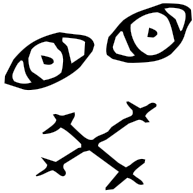 金文 bronze · 西周晚期
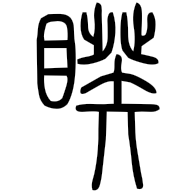 篆文 seal
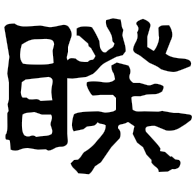 隸書 clerical · 東漢
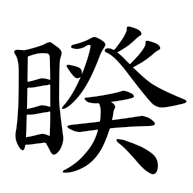 楷書 regular
Legge's note (1882)
Legge's title for the hexagram: division and disunion.
XXXVIII. Khwei denotes a social state in which division and mutual alienation prevail, and the hexagram teaches how in small matters this condition may be healed, and the way prepared for the cure of the whole system. The writer or writers of Appendixes I and II point out the indication in the figure of division and disunion according to their views. In Appendix VI those things appear as a necessary sequel to the regulation of the family; while it is impossible to discover any allusion to the family in the Text. Line 1 is strong, and in an odd place. A successful course might be auspiced for its subject; but the correlate in line 4 is also strong; and therefore disappointment and repentance are likely to ensue. In the condition, however, indicated by Khwei, where people have a common virtue, they will help one another. Through the good services of 4, the other will not have to repent. His condition may be emblemed by a traveller’s loss of his horses, which return to him of themselves. Should he meet with bad men, however, let him not shrink from them. Communication with them will be of benefit. His good may overcome their evil, and at least it will help to silence their slanderous tongues. Line 5 is weak, and its subject is the proper correlate of the strong 2. They might meet openly; but for the separation and disunion that mark the time. A casual, as it were a stolen, interview, as in a bye-lane or passage, however will be useful, and may lead on to a better understanding. Line 3 is weak, where it ought to be strong. Its correlate, however, in 6 is strong, and the relation between them might seem what it ought to be. But the weak 3 is between the strong lines in 2 and 4; and in a time of disunion there ensue the checking and repulsion emblemed in the Text. At the same time the subject of line 6 inflicts on that of 3 the punishments which are mentioned. It is thus bad for 3 at first, but we are told that in the end it will be well with him; and this will be due to the strength of the sixth line. The conclusion grows out of a conviction in the mind of the author that what is right and good is destined to triumph over what is wrong and bad. Disorder shall in the long run give place to order, and disunion to union. Line 4 has no proper correlate, and might seem to be solitary. But, as we saw on line 1, in this hexagram, correlates of the same class help each other. Hence the subjects of 4 and 1, meeting together, work with good will and success. The place of 5 is odd, but the line itself is weak, so that there might arise occasion for repentance. But the strong 2 is a proper correlate to the weak 5. Five being the sovereign’s place, the subject of 2 is styled the sovereign’s relative, of the same surname with him, and head of some branch of the descendants of the royal house. It is as easy for 5, so supported, to deal with the disunion of the time, as to bite through a piece of skin. Line 6 is an even place, and yet the line is strong;—what can its subject effect? He looks at 3, which, as weak, is a proper correlate; but he looks with the evil eye of disunion. The subject of 3 appears no better than a filthy pig, nor more real than an impossible carriage-load of ghosts. He bends his bow against him, but he unbends it, discovering a friend in 3, as 1 did in 4, and 5 in 2. He acts and with good luck, comparable to the falling rain, which results from the happy union of the yang and yin in nature.
Sources
- Chinese text: 周易, 維基文庫, page (revision 10646622); the text is public domain, the site's edits CC BY-SA 4.0.
- English: James Legge, The Yî King, Sacred Books of the East vol. XVI, Oxford 1882 (public domain), where this hexagram is “Khwei”.
- Glyph images: 小學堂 字形演變, Academia Sinica (CC0 1.0).
- Pinyin: Unihan (Unicode License v3) with this site's readings for the classical cases. English gloss, relations, the idiom glosses, the English of the chronicle passages and the plain reading: this site.