- The 64
- Hexagram 63
63 既濟 Already Across
離 Fire below, 坎 Water above
Water over fire, every line in its proper place: the crossing already made. The text says it gets through, and that a finished thing begins to come apart.
Tap a line of the figure to see where it leads when it changes. Cast for a question of your own. New here? What the I Ching is, coming from tarot.
This site's reading
卦辭 既濟 means already across. The Judgment: it gets through; small matters benefit from holding firm; good at the start, disorder at the end (初吉終亂). It is the one figure in which every line sits in its proper place: perfect order, with nowhere further to go.
彖 The commentary reads the getting-through as the getting-through of small things, the correctness as every line in its proper position, the good start as the yielding line in the middle of the lower trigram, and the ending plainly: 終止則亂,其道窮也, when it stops at the end there is disorder, because the way is exhausted. Completion is not a resting place.
大象 Water above fire. The noble person thinks of trouble ahead and guards against it in advance, 思患而豫防之. When things have worked, prepare for when they will not.
爻 The lines move from caution to danger: the carriage wheel dragged and the fox's tail wet, no blame; a lost carriage screen that comes back in seven days without chasing it; a three-year campaign that is won, with a warning not to use small men; rags kept ready for the leak, on guard all day; the neighbour's modest offering worth more than a slaughtered ox; and at the top, the head in the water, danger. Order holds while it is tended; the top line is what forgets to tend it.
If your question is about
- A relationship
- The crossing is made and every piece is in place; the danger now is forgetting to tend it. Small care, kept up, is the counsel.
- Work
- Finished, and therefore fragile. Guard against the trouble that follows success; the campaign is won, small men are not to be used.
- A decision
- Do not start something large on the strength of a completion. Hold firm in small matters; this way is exhausted at its end.
- No line changing
- Order holds as long as it is tended. Nothing turns, so nothing rescues neglect: prepare for the leak before it comes.
Written from the text above and checked against it by Lun (2026-10-24). It is a way of reading the hexagram, not a prediction.
The text, with Legge
Judgment 卦辭
既濟:亨小。利貞。初吉終亂。
Kî Ȝî intimates progress and success in small matters. There will be advantage in being firm and correct. There has been good fortune in the beginning; there may be disorder in the end. (Legge, 1882)
Commentary on the Judgment 彖
既濟,亨,小者亨也。利貞,剛柔正而位當也。初吉,柔得中也。終止則亂,其道窮也。
The Image 大象
水在火上,既濟;君子以思患而豫防之。
The six lines
Line 1 初九
曳其輪,濡其尾,无咎。
The first line, undivided, (shows its subject as a driver) who drags back his wheel, (or as a fox) which has wet his tail. There will be no error. (Legge, 1882)
The Image 小象
曳其輪,義无咎也。
Changing, this line leads to 39 蹇 Jiǎn.
Line 2 六二
婦喪其茀,勿逐,七日得。
The second line, divided, (shows its subject as) a wife who has lost her (carriage-)screen. There is no occasion to go in pursuit of it. In seven days she will find it. (Legge, 1882)
The Image 小象
七日得,以中道也。
Changing, this line leads to 5 需 Xū.
Line 3 九三
高宗伐鬼方,三年克之,小人勿用。
The third line, undivided, (suggests the case of) Kâo Ȝung who attacked the Demon region, but was three years in subduing it. Small men should not be employed (in such enterprises). (Legge, 1882)
The Image 小象
三年克之,憊也。
Changing, this line leads to 3 屯 Zhūn.
Line 4 六四
繻有衣袽,終日戒。
The fourth line, divided, shows its subject with rags provided against any leak (in his boat), and on his guard all day long. (Legge, 1882)
The Image 小象
終日戒,有所疑也。
Changing, this line leads to 49 革 Gé.
Line 5 九五
東鄰殺牛,不如西鄰之禴祭,實受其福。
The fifth line, undivided, shows its subject (as) the neighbour in the east who slaughters an ox (for his sacrifice); but this is not equal to the (small) spring sacrifice of the neighbour in the west, whose sincerity receives the blessing. (Legge, 1882)
The Image 小象
東鄰殺牛,不如西鄰之時也;實受其福,吉大來也。
Changing, this line leads to 36 明夷 Míng Yí.
Line 6 上六
濡其首,厲。
The topmost line, divided, shows its subject with (even) his head immersed. The position is perilous. (Legge, 1882)
The Image 小象
濡其首厲,何可久也。
Changing, this line leads to 37 家人 Jiā Rén.
Related hexagrams
Where the name comes from
既
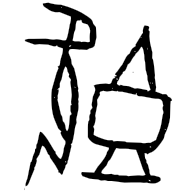 甲骨文 oracle bone · 商
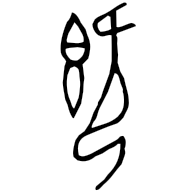 金文 bronze · 商代晚期
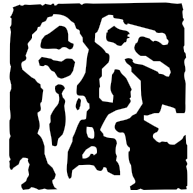 戰國文字 Warring States · 春秋晚期或戰國早期.秦
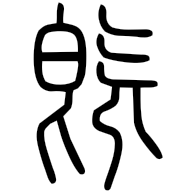 篆文 seal
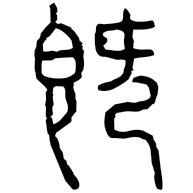 隸書 clerical · 秦
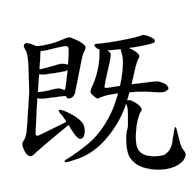 楷書 regular
濟
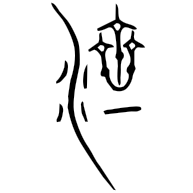 金文 bronze · 戰國晚期.晉
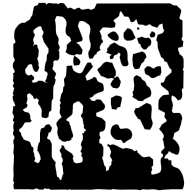 戰國文字 Warring States · 春秋晚期或戰國早期.秦
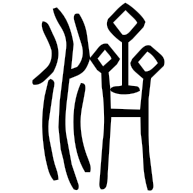 篆文 seal
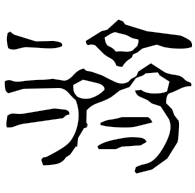 隸書 clerical · 西漢
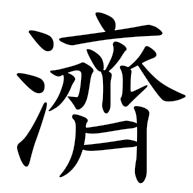 楷書 regular
Legge's note (1882)
Legge's title for the hexagram: past or completed.
LXIII. The character called Kî is used as a symbol of being past or completed. Ȝî denotes primarily crossing a stream, and has the secondary meaning of helping and completing. The two characters, combined, will express the successful accomplishment of whatever the writer has in his mind. In dealing with this lineal figure, king Wăn was thinking of the condition of the kingdom, at length at rest and quiet. The vessel of the state has been brought safely across the great and dangerous stream. The distresses of the kingdom have been relieved, and its disorders have been repressed. Does anything remain to be done still? Yes, in small things. The new government has to be consolidated. Its ruler must, without noise or clamour, go on to perfect what has been wrought, with firmness and correctness, and ever keeping in mind the instability of all human affairs. That every line of the hexagram is in its correct place, and has its proper correlate is also supposed to harmonize with the intimation of progress and success. Line 1, the first of the hexagram, represents the time immediately after the successful achievement of the enterprise it denotes;—the time for resting and being quiet. For a season, at least, all movement should be hushed. Hence we have the symbolism of a driver trying to stop his carriage, and a fox who has wet his tail, and will not tempt the stream again. Line 2 is weak, and in its proper place. It also has the strong correlate 5; and might be expected to be forward to act. But it occupies its correct and central place, and suggests the symbol of a lady whose carriage has lost its screen. She will not advance further so soon after success has been achieved; but keep herself hidden and retired. Let her not try to find the screen. When it is said that she will find this ‘after seven days,’ the meaning seems to be simply this, that the period of Kî Ȝî will then have been exhausted, the six lines having been gone through, and a new period, when action will be proper, shall have commenced. The strong line 3, at the top of the lower trigram, suggests for its subject one undertaking a vigorous enterprise. The writer thinks of Kâo Ȝung, the sacrificial title of Wû Ting, one of the ablest sovereigns of the Shang dynasty (B.C. 1364-1324), who undertook an expedition against the barbarous hordes of the cold and bleak regions north of the Middle States. He is mentioned again under the next hexagram. He appears also in the Shû, IV, ix, and in the Shih, IV, iii, ode 5. His enterprise may have been good, and successful, but it was tedious, and the paragraph concludes with a caution. Line 4 is weak, and has advanced into the trigram for water. Its subject will be cautious, and prepare for evil, as in the symbolism, suggested probably by the nature of the trigram. ‘The neighbour in the East’ is the subject of line 5, and ‘the neighbour in the West’ is the subject of the correlate 2, the former quarter being yang and the latter yin. Line 5 is strong, and 2 is weak; but weakness is more likely to be patient and cautious than strength. They are compared to two men sacrificing. The one presents valuable offerings; the other very poor ones. But the second excels in sincerity, and his small offering is the more acceptable. The topmost line is weak, and on the outmost edge of Khân, the trigram of peril. His action is violent and perilous, like that one attempting to cross a ford, and being plunged overhead into the water.
Sources
- Chinese text: 周易, 維基文庫, page (revision 2572417); the text is public domain, the site's edits CC BY-SA 4.0.
- English: James Legge, The Yî King, Sacred Books of the East vol. XVI, Oxford 1882 (public domain), where this hexagram is “Kî Ȝî”.
- Glyph images: 小學堂 字形演變, Academia Sinica (CC0 1.0).
- Pinyin: Unihan (Unicode License v3) with this site's readings for the classical cases. English gloss, relations, the idiom glosses, the English of the chronicle passages and the plain reading: this site.