- The 64
- Hexagram 14
14 大有 Great Holdings
乾 Heaven below, 離 Fire above
Fire high in the sky, lighting everything: great holdings, abundance. The text gives it two characters, 元亨, greatly getting through, and the lines say how to hold much without harm.
Tap a line of the figure to see where it leads when it changes. Cast for a question of your own. New here? What the I Ching is, coming from tarot.
This site's reading
卦辭 The shortest Judgment: 元亨, great, penetrating. A single yielding line in the ruler's place with five strong lines answering it: much is held because the one who holds it is open.
彖 The commentary: the yielding gains the honoured place, great and central, and above and below respond, so it is great holdings. Its virtue is firm, strong, cultured and bright; it answers heaven and moves with the time; hence great success.
大象 Fire above heaven: the noble person suppresses evil and raises up the good, following heaven's gracious command. Abundance is a charge, not a prize.
爻 The lines: no dealings with harm, no blame, hardship keeps it so; a great cart loaded, going somewhere, no blame; a prince presenting to the Son of Heaven, which a small man cannot do; not using his strength, no blame; sincerity reciprocated, with dignity, good; and at the top helped by heaven, good, nothing not advantageous. The fourth line is the key: holding much and not flexing it.
If your question is about
- A relationship
- Much given, much held; the fifth line's sincerity met by sincerity, with dignity, is the model. Do not use the surplus as power (line 4).
- Work
- A loaded cart that can go anywhere (line 2). Offer upward, restrain the strength, and the top line's help follows.
- A decision
- Go; this is the hexagram of plenty. Keep it hard on yourself (line 1), and keep the plenty for raising the good.
- No line changing
- Abundance that stays. The charge is in the Image: suppress the bad, raise the good; wealth kept open stays held.
Written from the text above and checked against it by Lun (2026-10-24). It is a way of reading the hexagram, not a prediction.
The text, with Legge
Judgment 卦辭
大有:元亨。
Tâ Yû indicates that, (under the circumstances which it implies), there will be great progress and success. (Legge, 1882)
Commentary on the Judgment 彖
大有,柔得尊位,大中而上下應之,曰大有。其德剛健而文明,應乎天而時行,是以元亨。
The Image 大象
火在天上,大有;君子以遏惡揚善,順天休命。
The six lines
Line 1 初九
无交害,匪咎,艱則无咎。
In the first line, undivided, there is no approach to what is injurious, and there is no error. Let there be a realisation of the difficulty (and danger of the position), and there will be no error (to the end). (Legge, 1882)
The Image 小象
大有初九,无交害也。
Changing, this line leads to 50 鼎 Dǐng.
Line 2 九二
大轝以載,有攸往,无咎。
In the second line, undivided, we have a large waggon with its load. In whatever direction advance is made, there will be no error. (Legge, 1882)
The Image 小象
大轝以載,積中不敗也。
Changing, this line leads to 30 離 Lí.
Line 3 九三
公用亨于天子,小人弗克。
The third line, undivided, shows us a feudal prince presenting his offerings to the Son of Heaven. A small man would be unequal (to such a duty). (Legge, 1882)
The Image 小象
公用亨于天子,小人害也。
Changing, this line leads to 38 睽 Kuí.
Line 4 九四
匪其尫,无咎。
The fourth line, undivided, shows its subject keeping his great resources under restraint. There will be no error. (Legge, 1882)
The Image 小象
匪其彭,无咎;明辨晰也。
Changing, this line leads to 26 大畜 Dà Chù.
Line 5 六五
厥孚交如,威如;吉。
The fifth line, divided, shows the sincerity of its subject reciprocated by that of all the others (represented in the hexagram). Let him display a proper majesty, and there will be good fortune. (Legge, 1882)
The Image 小象
厥孚交如,信以發志也。威如之吉,易而无備也。
Changing, this line leads to 1 乾 Qián.
Line 6 上九
自天佑之,吉无不利。
The topmost line, undivided, shows its subject with help accorded to him from Heaven. There will be good fortune, advantage in every respect. (Legge, 1882)
The Image 小象
大有上吉,自天佑也。
Changing, this line leads to 34 大壯 Dà Zhuàng.
In history
The 左傳 and 國語, the chronicles of the sixth to fifth centuries BC, record real casts of the Changes and what came of them. 2 of them gave this hexagram.
660 BC: 魯桓公, before the birth of his son 季友 (成季)
Asked: What will this child be? The stalks gave 14 大有 with line 5 changing, to 1 乾.
同復于父,敬如君所。After the turtle oracle promised a son named 友 who would stand at the duke's right hand and prop up the ducal house, the stalks were also cast and gave 大有 moving to 乾. The reading: he will return to the standing of his father, and be honoured as if he were the ruler himself.
The boy was born with a mark on his hand read as 友 and named for it. He founded the 季孫 family, which ran 魯 for the next three centuries.
左傳 閔公二年, 維基文庫 (revision 2675997). Told in retrospect; the cast was made before 桓公's death in 694 BC, the year given is that of the passage. The reading quotes an oracle sentence not found in the received text of 大有.
635 BC: 晉文公, on marching to restore King 襄 of 周 to his capital
Asked: Should 晉 escort the king home? The stalks gave 14 大有 with line 3 changing, to 38 睽.
吉。遇公用享于天子之卦也。戰克而王饗,吉孰大焉。The turtle gave the omen of 黃帝's battle at 阪泉; the duke doubted he could bear so great a sign, so the stalks were cast too. 卜偃 read the third line of 大有, 'the prince is received at the Son of Heaven's feast', as the best fortune possible: victory, then a royal banquet, heaven bending down to the duke.
文公 marched, killed the usurping 大叔帶, and brought the king back into 王城. The king feasted him and granted him 陽樊, 溫, 原 and 欑茅.
左傳 僖公二十五年, 維基文庫 (revision 10199429). The line text 公用享于天子 matches the received 大有 九三. The 國語 晉語四 carries no separate record of this cast.
The chronicles' diviners read from oracle texts of their own time; where their words match our clause text the note says so, and where they do not, it says that. None of this is a claim that the text foretold the event.
Related hexagrams
Where the name comes from
大
 甲骨文 oracle bone · 商
 金文 bronze · 西周早期
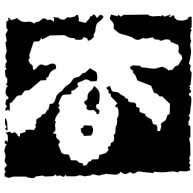 戰國文字 Warring States · 戰國.齊
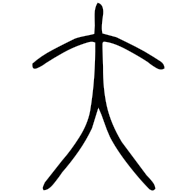 篆文 seal
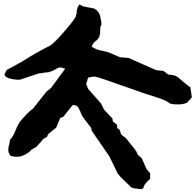 隸書 clerical · 秦
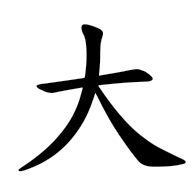 楷書 regular
有
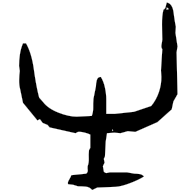 甲骨文 oracle bone · 商
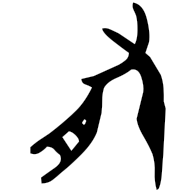 金文 bronze · 西周早期
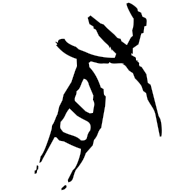 戰國文字 Warring States · 春秋晚期或戰國早期.晉
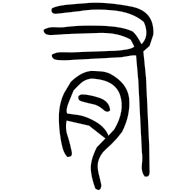 篆文 seal
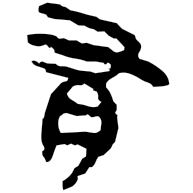 隸書 clerical · 秦
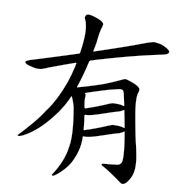 楷書 regular
Legge's note (1882)
Legge's title for the hexagram: Great Havings.
XIV. Tâ Yû means ‘Great Havings;’ denoting in a kingdom a state of prosperity and abundance, and in a family or individual, a state of opulence. The danger threatening such a condition arises from the pride which it is likely to engender. But everything here is against that issue. Apart from the symbolism of the trigrams, we have the place of honour occupied by a weak line, so that its subject will be humble; and all the other lines, strong as they are, will act in obedient sympathy. There will be great progress and success. Line 1, though strong, is at the lowest part of the figure, and has no correlate above. No external influences have as yet acted injuriously on its subject. Let him do as directed, and no hurtful influence will ever affect him. The strong line 2 has its proper correlate in line 5, the ruler of the figure, and will use its strength in subordination to his humility. Hence the symbolism. Line 3 is strong, and in the right (an odd) place. The topmost line of the lower trigram is the proper place for a feudal lord. The subject of this will humbly serve the condescending ruler in line 5. A small man, having the place without the virtue, would give himself airs. Line 4 is strong, but the strength is tempered by the position, which is that of a weak line. Hence he will do no injury to the mild ruler, to whom he is so near. Line 5 symbolises the ruler. Mild sincerity is good in him, and affects his ministers and others. But a ruler must not be without an awe-inspiring majesty. Even the topmost line takes its character from 5. The strength of its subject is still tempered, and Heaven gives its approval.
Sources
- Chinese text: 周易, 維基文庫, page (revision 10645712); the text is public domain, the site's edits CC BY-SA 4.0.
- English: James Legge, The Yî King, Sacred Books of the East vol. XVI, Oxford 1882 (public domain), where this hexagram is “Tâ Yû”.
- Glyph images: 小學堂 字形演變, Academia Sinica (CC0 1.0).
- Pinyin: Unihan (Unicode License v3) with this site's readings for the classical cases. English gloss, relations, the idiom glosses, the English of the chronicle passages and the plain reading: this site.