- The 64
- Hexagram 27
27 頤 Nourishment
震 Thunder below, 艮 Mountain above
A mouth, open: the jaws, nourishment. The text says firmness is good, and tells you to look at what you nourish and how you fill your own mouth.
Tap a line of the figure to see where it leads when it changes. Cast for a question of your own. New here? What the I Ching is, coming from tarot.
This site's reading
卦辭 貞吉。觀頤,自求口實: with firmness, good; look at the jaws, and seek the food for your own mouth yourself. The hexagram's shape is the thing itself: two solid lines around a hollow.
彖 The commentary: nourishing what is correct is good; look at what one nourishes, and look at how one nourishes oneself. Heaven and earth nourish all things, the sage nourishes the worthy and so reaches all the people. "Great is the time of nourishment" (頤之時大矣哉).
大象 Thunder below the mountain: the noble person is careful in speech and moderate in food and drink. The mouth takes in and gives out; both are nourishment.
爻 The lines: leaving your own sacred tortoise to watch my jaws, evil; nourishment turned upside down, against the rule, from the hill, going is evil; against nourishment, firm and yet evil, ten years unusable; nourishment turned upside down and good, a tiger's gaze, its desire pursuing, no blame; against the rule, staying firm is good, do not cross the stream; and at the top the source of nourishment, perilous and good, cross the great stream. Who feeds whom, and whether you envy another's mouth, is the whole hexagram.
If your question is about
- A relationship
- Who nourishes whom. Envying another's food (line 1) is the evil; feeding others from the top (line 6) is perilous and good.
- Work
- Look at what you are feeding and how you feed yourself (the Judgment). Careful words, moderate appetite (the Image).
- A decision
- Firmness is good; the stream is crossed only from the sixth line, the one who is the source. Elsewhere, stay and nourish.
- No line changing
- Nourishment as a state: the open mouth. Mind what goes in and what comes out; the time of nourishment is great.
Written from the text above and checked against it by Lun (2026-10-24). It is a way of reading the hexagram, not a prediction.
The text, with Legge
Judgment 卦辭
頤:貞吉。觀頤,自求口實。
Î indicates that with firm correctness there will be good fortune (in what is denoted by it). We must look at what we are seeking to nourish, and by the exercise of our thoughts seek for the proper aliment. (Legge, 1882)
Commentary on the Judgment 彖
頤貞吉,養正則吉也。觀頤,觀其所養也;自求口實,觀其自養也。天地養萬物,聖人養賢,以及萬民;頤之時大矣哉!
The Image 大象
山下有雷,頤;君子以慎言語,節飲食。
The six lines
Line 1 初九
舍爾靈龜,觀我朵頤,凶。
The first line, undivided, (seems to be thus addressed), ‘You leave your efficacious tortoise, and look at me till your lower jaw hangs down.’ There will be evil. (Legge, 1882)
The Image 小象
觀我朵頤,亦不足貴也。
Changing, this line leads to 23 剝 Bō.
Line 2 六二
顛頤,拂經,于丘頤,征凶。
The second line, divided, shows one looking downwards for nourishment, which is contrary to what is proper; or seeking it from the height (above), advance towards which will lead to evil. (Legge, 1882)
The Image 小象
六二征凶,行失類也。
Changing, this line leads to 41 損 Sǔn.
Line 3 六三
拂頤,貞凶,十年勿用,无攸利。
The third line, divided, shows one acting contrary to the method of nourishing. However firm he may be, there will be evil. For ten years let him not take any action, (for) it will not be in any way advantageous. (Legge, 1882)
The Image 小象
十年勿用,道大悖也。
Changing, this line leads to 22 賁 Bì.
Line 4 六四
顛頤吉,虎視眈眈,其欲逐逐,无咎。
The fourth line, divided, shows one looking downwards for (the power to) nourish. There will be good fortune. Looking with a tiger’s downward unwavering glare, and with his desire that impels him to spring after spring, he will fall into no error. (Legge, 1882)
The Image 小象
顛頤之吉,上施光也。
Changing, this line leads to 21 噬嗑 Shì Kè.
Line 5 六五
拂經,居貞吉,不可涉大川。
The fifth line, divided, shows one acting contrary to what is regular and proper; but if he abide in firmness, there will be good fortune. He should not, (however, try to) cross the great stream. (Legge, 1882)
The Image 小象
居貞之吉,順以從上也。
Changing, this line leads to 42 益 Yì.
Line 6 上九
由頤,厲吉,利涉大川。
The sixth line, undivided, shows him from whom comes the nourishing. His position is perilous, but there will be good fortune. It will be advantageous to cross the great stream. (Legge, 1882)
The Image 小象
由頤厲吉,大有慶也。
Changing, this line leads to 24 復 Fù.
Words that came from it
Phrases a billion people use today began as clauses of this hexagram.
- 虎視眈眈
- glaring like a tiger. To eye something hungrily; said of rivals and competitors. From line 4: 虎視眈眈.
- 大快朵頤
- to eat with great relish. 朵頤, the moving jaw, is this line's; the four-character idiom is a later expansion. From line 1: 觀我朵頤.
Related hexagrams
Where the name comes from
頤
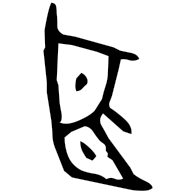 金文 bronze · 春秋早期
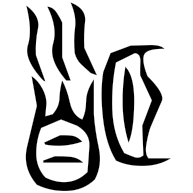 篆文 seal
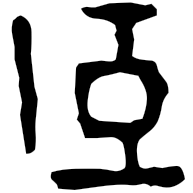 隸書 clerical · 東漢至魏晉
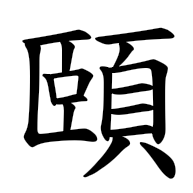 楷書 regular
Legge's note (1882)
Legge's title for the hexagram: nourishing.
XXVII. Î is the symbol of the upper jaw, and gives name to the hexagram; but the whole figure suggests the appearance of the mouth. There are the two undivided lines at the bottom and top, and the four divided lines between them. The first line is the first in the trigram Kăn, denoting movement; and the sixth is the third in Kăn, denoting what is solid. The former is the lower jaw, part of the mobile chin; and the other the more fixed upper jaw. The open lines are the cavity of the mouth. As the name of the hexagram, Î denotes nourishing,—one’s body or mind, one’s self or others. The nourishment in both the matter and method will differ according to the object of it; and every one must determine what to employ and do in every case by exercising his own thoughts, only one thing being premised,—that in both respects the nourishing must be correct, and in harmony with what is right. The auspice of the whole hexagram is good. The first line is strong, and in its proper place; its subject might suffice for the nourishing of himself, like a tortoise, which is supposed to live on air, without more solid nourishment. But he is drawn out of himself by desire for the weak 4, his proper correlate, at whom he looks till his jaw hangs down, or, as we say, his mouth waters. Hence the auspice is bad. The symbolism takes the form of an expostulation addressed, we must suppose, by the fourth line to the first. The weak 2, insufficient for itself, seeks nourishment first from the strong line below, which is not proper, and then from the strong 6, not its proper correlate, and too far removed. In either case the thing is evil. Line 3 is weak, in an odd place; and as it occupies the last place in the trigram of movement, all that quality culminates in its subject. Hence he considers himself sufficient for himself, without any help from without, and the issue is bad. With line 4 we pass into the upper trigram. It is next to the ruler’s place in 5 moreover, and bent on nourishing and training all below. Its proper correlate is the strong 1; and though weak in himself, its subject looks with intense desire to the subject of that for help; and there is no error. The subject of line 5 is not equal to the requirements of his position; but with a firm reliance on the strong 6, there will be good fortune. Let him not, however, engage in the most difficult undertakings. The topmost line is strong, and 5 relies on its subject; but being penetrated with the idea of the hexagram, he feels himself in the position of master or tutor to all under heaven. The task is hard and the responsibility great; but realising these things, he will prove himself equal to them.
Sources
- Chinese text: 周易, 維基文庫, page (revision 10643091); the text is public domain, the site's edits CC BY-SA 4.0.
- English: James Legge, The Yî King, Sacred Books of the East vol. XVI, Oxford 1882 (public domain), where this hexagram is “Δ.
- Glyph images: 小學堂 字形演變, Academia Sinica (CC0 1.0).
- Pinyin: Unihan (Unicode License v3) with this site's readings for the classical cases. English gloss, relations, the idiom glosses, the English of the chronicle passages and the plain reading: this site.