- The 64
- Hexagram 50
50 鼎 The Cauldron
巽 Wind below, 離 Fire above
Wood feeding fire: the cauldron, the vessel that cooks for the offering. The text says greatly good, it gets through; the pair of Reform, where the old is broken down, this is where the new is cooked.
Tap a line of the figure to see where it leads when it changes. Cast for a question of your own. New here? What the I Ching is, coming from tarot.
This site's reading
卦辭 元吉,亨: greatly good; it gets through. The hexagram's shape is the vessel: a foot at the bottom, a belly, ears, and the carrying rings at the top.
彖 The commentary: the cauldron is an image. Wood under fire is cooking; the sage cooks to offer to the Highest, and cooks greatly to nourish the worthy. Gentle, with ears and eyes keen; the yielding advances and rises, gains the centre and answers the firm, hence great success.
大象 Fire above wood: the noble person makes his position correct and settles the mandate (正位凝命). The cauldron stands straight or it spills.
爻 The lines: the cauldron tipped on its feet, good for emptying the bad, taking a concubine for the son's sake, no blame; the cauldron full, my rival is sick and cannot reach me, good; the cauldron's ears changed, its moving blocked, the pheasant's fat uneaten, rain comes and regret fades, good at the end; the cauldron's leg broken, the prince's stew spilled, the penalty heavy, evil; yellow ears and metal rings, firmness advantageous; and at the top jade rings, greatly good, nothing not advantageous. From a vessel tipped to empty it, to one carried by jade.
If your question is about
- A relationship
- A vessel that nourishes when it stands straight; emptying the old (line 1) is allowed, breaking the leg (line 4) is not. Right handles.
- Work
- Cook for the offering and for the worthy (the commentary); the position correct, the mandate settled (the Image). Carry only what the leg bears.
- A decision
- Greatly good: go, with the vessel straight. The rival cannot reach a full cauldron (line 2).
- No line changing
- The cauldron as a state: nourishment kept cooking. Keep the handles right and the foot sound; the rings go from metal to jade.
Written from the text above and checked against it by Lun (2026-10-24). It is a way of reading the hexagram, not a prediction.
The text, with Legge
Judgment 卦辭
鼎:元吉,亨。
Ting gives the intimation of great progress and success. (Legge, 1882)
Commentary on the Judgment 彖
鼎,象也。以木巽火,亨飪也。聖人亨以享上帝,而大亨以養聖賢。巽而耳目聰明,柔進而上行,得中而應乎剛,是以元亨。
The Image 大象
木上有火,鼎;君子以正位凝命。
The six lines
Line 1 初六
鼎顛趾,利出否,得妾以其子,无咎。
The first line, divided, shows the caldron overthrown and its feet turned up. (But) there will be advantage in its getting rid of what was bad in it. (Or it shows us) the concubine (whose position is improved) by means of her son. There will be no error. (Legge, 1882)
The Image 小象
鼎顛趾,未悖也。利出否,以從貴也。
Changing, this line leads to 14 大有 Dà Yǒu.
Line 2 九二
鼎有實,我仇有疾,不我能即,吉。
The second line, undivided, shows the caldron with the things (to be cooked) in it. (If its subject can say), ‘My enemy dislikes me, but he cannot approach me,’ there will be good fortune. (Legge, 1882)
The Image 小象
鼎有實,慎所之也。我仇有疾,終无尤也。
Changing, this line leads to 56 旅 Lǚ.
Line 3 九三
鼎耳革,其行塞,雉膏不食,方雨虧悔,終吉。
The third line, undivided, shows the caldron with (the places of) its ears changed. The progress (of its subject) is (thus) stopped. The fat flesh of the pheasant (which is in the caldron) will not be eaten. But the (genial) rain will come, and the grounds for repentance will disappear. There will be good fortune in the end. (Legge, 1882)
The Image 小象
鼎耳革,失其義也。
Changing, this line leads to 64 未濟 Wèi Jì.
Line 4 九四
鼎折足,覆公餗,其刑渥,凶。
The fourth line, undivided, shows the caldron with its feet broken; and its contents, designed for the ruler’s use, overturned and spilt. Its subject will be made to blush for shame. There will be evil. (Legge, 1882)
The Image 小象
覆公餗,信如何也。
Changing, this line leads to 18 蠱 Gǔ.
Line 5 六五
鼎黃耳金鉉,利貞。
The fifth line, divided, shows the caldron with yellow ears and rings of metal in them. There will be advantage through being firm and correct. (Legge, 1882)
The Image 小象
鼎黃耳,中以為實也。
Changing, this line leads to 44 姤 Gòu.
Line 6 上九
鼎玉鉉,大吉,无不利。
The sixth line, undivided, shows the caldron with rings of jade. There will be great good fortune, and all action taken will be in every way advantageous. (Legge, 1882)
The Image 小象
玉鉉在上,剛柔節也。
Changing, this line leads to 32 恒 Héng.
Words that came from it
Phrases a billion people use today began as clauses of this hexagram.
- 革故鼎新
- remove the old, set up the new. Made of the names of 革 and 鼎, which follow each other in the book; the 雜卦 says 革 removes the old and 鼎 takes the new. From the name.
Related hexagrams
Where the name comes from
鼎
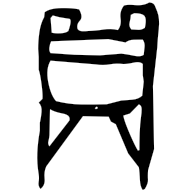 甲骨文 oracle bone · 商
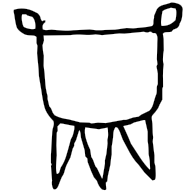 金文 bronze · 商代晚期
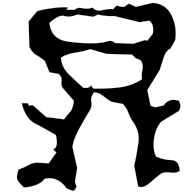 戰國文字 Warring States · 戰國.晉
 篆文 seal
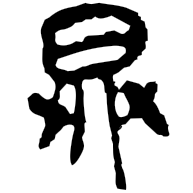 隸書 clerical · 西漢
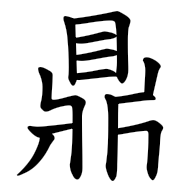 楷書 regular
Legge's note (1882)
Legge's title for the hexagram: a caldron.
L. Ting was originally a pictorial character, representing a caldron with three feet and two ears, used for cooking and preparing food for the table (the mat in old times) and the altar. The picture has disappeared from the character, but it is said that in the hexagram we have an outline from which fancy may construct the vessel. The lower line, divided, represents its feet; lines 2, 3, 4, all undivided, represent the body of it; line 5, divided, represents its two ears; and line 6, undivided, the handle by which it was carried, or suspended from a hook. Appendix VI makes Ting follow Ko in the order of the hexagrams, because there is no changer of the appearance and character of things equal to the furnace and caldron! Ting and Ȝing (48) are the only two hexagrams named from things in ordinary use with men; and they are both descriptive of the government’s work of nourishing. There are three hexagrams of which that is the theme, Î (27), under which we are told in Appendix I that ‘the sages nourished men of worth, by means of them to reach to the myriads of the people.’ Ȝing treats of the nourishment of the people generally by the government through its agricultural and other methods; Ting treats of the nourishment of men of talents and virtue; and that being understood, it is said, without more ado, that it ‘intimates great progress and success.’ The Text that follows, however, is more difficult to interpret than that of Ȝing. Line 1 is weak, and little or nothing can be expected from its subject. But it has a proper correlate in the strong 4; and the disastrous overthrow, causing the feet to be directed towards 4, is understood to be lucky, as accelerating the co-operation of their two lines! The overturned caldron is thereby emptied of bad stuff that had accumulated in it!! The writer uses another illustration, which comes to the same thing. A concubine is less honourable than a wife,—like the overthrown caldron. But if she have a son, while the proper wife has none, he will be his father’s heir, and the mother, the concubine, will share in the honour of his position. Thus the issue of what was so unpromising is good. At least ‘there is no mistake.’ The above is what is found in the best commentaries on the paragraph. I give it, but am myself dissatisfied with it. Line 2 is strong. ‘The enemy’ is the first line, which solicits 1. One, however, is able to resist the solicitation; and the whole paragraph gives a good auspice. The personal pronoun seems to show that the whole was, or was intended to be, understood as an oracular response in divination. This paragraph is rhymed, moreover, as are also 1, 3, and 4:— ‘In the caldron is good fare, See my foe with angry glare; But touch me he does not dare.’ Line 3 is also strong, and in the proper place; and if its correlate were the divided 5, its auspice would be entirely good. But instead of 5, its correlate is the strong 6. The place of the ears at 5 has been changed. Things promise badly. The advance of 3 is stopped. The good meat in the caldron which it symbolises will not be eaten. But 3 keeping firm 5 will by and by seek its society! The yin and the yang will mingle, and their union will be followed by genial rain. The issue will be good. Line 4 is in the place of a great minister, who is charged with the most difficult duties, which no single man can sustain. Then the strength of 4 is weakened by being in an even place, and its correlate is the weak 1 in the lowest place. Its subject is insufficient of himself for his work, and he has no sufficient help; and the result will be evil. ‘Paragraph 5,’ says the Daily Lecture, ‘praises the ruler as condescending to the worthy with his humble virtue.’ ‘Yellow’ has occurred repeatedly as ‘a correct colour;’ and here ‘the yellow ears and strong rings of metal’ are intended to intensify our appreciation of the occupant of 5. As the line is divided, a caution is added about being firm and correct. Line 6 is strong, but the strength is tempered by its being in an even place. It is this which makes the handle to be of jade, which, though very hard, is supposed to have a peculiar and rich softness of its own. The auspice of the line is very good. ‘The great minister,’ it is said, ‘the subject of 6,’ performs for the ruler, the subject of 5, in helping his government and nourishing the worthy, the part which the handle does for the caldron.
Sources
- Chinese text: 周易, 維基文庫, page (revision 10647086); the text is public domain, the site's edits CC BY-SA 4.0.
- English: James Legge, The Yî King, Sacred Books of the East vol. XVI, Oxford 1882 (public domain), where this hexagram is “Ting”.
- Glyph images: 小學堂 字形演變, Academia Sinica (CC0 1.0).
- Pinyin: Unihan (Unicode License v3) with this site's readings for the classical cases. English gloss, relations, the idiom glosses, the English of the chronicle passages and the plain reading: this site.