- The 64
- Hexagram 47
47 困 Hemmed In
坎 Water below, 兌 Lake above
A lake drained of its water: hemmed in, exhausted, trapped. The text says it still gets through, that firmness is good for the great person, and that words will not be believed.
Tap a line of the figure to see where it leads when it changes. Cast for a question of your own. New here? What the I Ching is, coming from tarot.
This site's reading
卦辭 亨,貞大人吉,无咎,有言不信: it gets through; firm, good for the great person; no blame; words are not believed. The way through confinement is not talk.
彖 The commentary: the firm is covered. Danger, and yet pleased; confined and not losing one's place, that gets through, and who can do it but the noble person? Firmness is good for the great person because the firm is central. Words not believed: relying on the mouth leads to exhaustion.
大象 The lake without water: the noble person gives his life to carry out his will (致命遂志). The counsel of confinement is to stake everything on what you are for.
爻 The lines: buttocks confined on a stump, into a dark valley, three years unseen; confined by wine and food, the red sash arriving, use it for the offering, going is evil, no blame; confined by a rock, grasping thorns, entering the house and not seeing the wife, evil; coming slowly, confined in a bronze carriage, regret, an end; nose and feet cut off, confined by the crimson sash, slowly there is release, use it for the sacrifice; and at the top confined by creepers, on a tottering height, moving brings regret, regret and then going is good. The way out is slow (line 5) and comes after admitting the regret (line 6).
If your question is about
- A relationship
- Trapped, and talk does not help (the Judgment). Keep your place in it; the release is slow (line 5) and follows admitting regret (line 6).
- Work
- Exhaustion with no water in the lake. Do not argue your way out; stake yourself on what you are for (the Image).
- A decision
- Hold firm and say little; words are not believed now. Going is evil in line 2 and good in line 6, once regret is faced.
- No line changing
- Confinement that holds. Keep your place, keep your will, and let the release come slowly; the mouth only deepens it.
Written from the text above and checked against it by Lun (2026-10-24). It is a way of reading the hexagram, not a prediction.
The text, with Legge
Judgment 卦辭
困:亨,貞大人吉,无咎,有言不信。
In (the condition denoted by) Khwăn there may (yet be) progress and success. For the firm and correct, the (really) great man, there will be good fortune. He will fall into no error. If he make speeches, his words cannot be made good. (Legge, 1882)
Commentary on the Judgment 彖
困,剛掩也。險以說,困而不失其所,亨;其唯君子乎? 貞大人吉,以剛中也。有言不信,尚口乃窮也。
The Image 大象
澤无水,困;君子以致命遂志。
The six lines
Line 1 初六
臀困于株木,入于幽谷,三歲不覿。
The first line, divided, shows its subject with bare buttocks straitened under the stump of a tree. He enters a dark valley, and for three years has no prospect (of deliverance). (Legge, 1882)
The Image 小象
入于幽谷,幽不明也。
Changing, this line leads to 58 兌 Duì.
Line 2 九二
困于酒食,朱紱方來,利用亨祀,征凶,无咎。
The second line, undivided, shows its subject straitened amidst his wine and viands. There come to him anon the red knee-covers (of the ruler). It will be well for him (to maintain his sincerity as) in sacrificing. Active operations (on his part) will lead to evil, but he will be free from blame. (Legge, 1882)
The Image 小象
困于酒食,中有慶也。
Changing, this line leads to 45 萃 Cuì.
Line 3 六三
困于石,據于蒺蔾,入于其宮,不見其妻,凶。
The third line, divided, shows its subject straitened before a (frowning) rock. He lays hold of thorns. He enters his palace, and does not see his wife. There will be evil. (Legge, 1882)
The Image 小象
據于蒺藜,乘剛也。入于其宮,不見其妻,不祥也。
Changing, this line leads to 28 大過 Dà Guò.
Line 4 九四
來荼荼,困于金轝,吝,有終。
The fourth line, undivided, shows its subject proceeding very slowly (to help the subject of the first line), who is straitened by the carriage adorned with metal in front of him. There will be occasion for regret, but the end will be good. (Legge, 1882)
The Image 小象
來徐徐,志在下也。雖不當位,有與也。
Changing, this line leads to 29 坎 Kǎn.
Line 5 九五
劓刖,困于赤紱,乃徐有說,利用祭祀。
The fifth line, undivided, shows its subject with his nose and feet cut off. He is straitened by (his ministers in their) scarlet aprons. He is leisurely in his movements, however, and is satisfied. It will be well for him to be (as sincere) as in sacrificing (to spiritual beings). (Legge, 1882)
The Image 小象
劓刖,志未得也。乃徐有說,以中直也。利用祭祀,受福也。
Changing, this line leads to 40 解 Xiè.
Line 6 上六
困于葛藟,于臲卼,曰動悔。有悔,征吉。
The sixth line, divided, shows its subject straitened, as if bound with creepers; or in a high and dangerous position, and saying (to himself), ‘If I move, I shall repent it.’ If he do repent of former errors, there will be good fortune in his going forward. (Legge, 1882)
The Image 小象
困于葛藟,未當也。動悔,有悔,吉行也。
Changing, this line leads to 6 訟 Sòng.
In history
The 左傳 and 國語, the chronicles of the sixth to fifth centuries BC, record real casts of the Changes and what came of them. One of them gave this hexagram.
548 BC: 崔杼 (崔武子), minister of 齊, on marrying the widow 棠姜
Asked: May I take this woman as my wife? The stalks gave 47 困 with line 3 changing, to 28 大過.
夫從風.風隕妻.不可聚也.且其繇曰.困于石.據于蒺梨.入于其宮.不見其妻.凶.The court scribes all called it lucky. 陳文子 did not: the husband follows the wind and the wind throws the wife down, so she should not be taken. He read the third line of 困, stuck against a rock, leaning on thorns, going into the house and not finding the wife, as misfortune with no way home.
崔杼 married her anyway. 齊莊公 took up with her, and in 548 BC 崔杼 had the duke killed. In 546 BC his sons fought over the succession, his house was destroyed, his wife hanged herself and so did he.
左傳 襄公二十五年, 維基文庫 (revision 2179112). The line text 困于石 matches the received 困 六三 (the page writes 蒺梨 for the received 蒺蔾). The 襄公 page transcludes this year from a subpage; the URL is that subpage.
The chronicles' diviners read from oracle texts of their own time; where their words match our clause text the note says so, and where they do not, it says that. None of this is a claim that the text foretold the event.
Related hexagrams
Where the name comes from
困
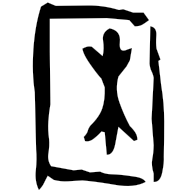 甲骨文 oracle bone · 商
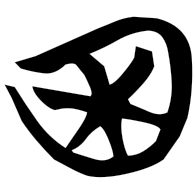 戰國文字 Warring States · 戰國.楚
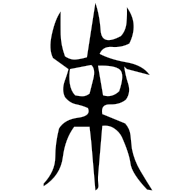 篆文 seal
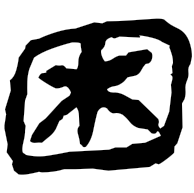 隸書 clerical · 秦
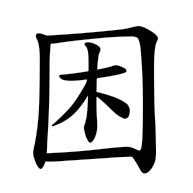 楷書 regular
Legge's note (1882)
Legge's title for the hexagram: straitened and distressed.
XLVII. The character Khwăn presents us with the picture of a tree within an enclosure; ‘a plant,’ according to Williams, ‘fading for want of room;’ ‘a tree,’ according to Tai Tung, ‘not allowed to spread its branches.’ However this be, the term conveys the idea of being straitened and distressed; and this hexagram indicates a state of things in which the order and government that would conduce to the well-being of the country can hardly get the development, which, by skilful management on the part of ‘the great man’ and others, is finally secured for them. Looking at the figure we see that the two central places are occupied by strong lines; but 2 is confined between 1 and 3, both of which are weak, and 5 (the ruler), as well as 4 (his minister), is covered by the weak 6; all which peculiarities are held to indicate the repression or straitening of good men by bad. For the way in which the same view is derived from the great symbolism, see Appendix II, in loc. The concluding sentence of the Thwan is literally, ‘If he speak, he will not be believed;’ but the Khang-hsî editors give sufficient reasons for changing one character so as to give the meaning in the translation. ‘Actions,’ not words, are what are required in the case. The symbolism of ‘buttocks’ is rather a favourite with the duke of Kâu;—‘chacun à son goût.’ The poor subject of line 1 sitting on a mere stump, which affords him no shelter, is indeed badly off. The line is at the bottom of the trigram indicating peril, and 4, which is its proper correlate, is so circumstanced as not to be able to render it help; hence comes the unfavourable auspice. ‘Three years’ is used, as often, for a long time. The three strong lines in the figure (2, 4, and 5) are all held to represent ‘superior men;’ and their being straitened is not in their persons or estates, but in their principles which are denied development. Hence the subject of 2 is straitened while he fares sumptuously. His correlate in 5, though not quite proper, occupies the ruler’s place, and comes to his help. That it is the ruler who comes appears from his red or vermillion knee-covers, different from the scarlet knee-covers worn by nobles, as in paragraph 5. Let 2 cultivate his sincerity and do the work of the hexagram as if he were sacrificing to spiritual beings; and then, if he keep quiet, all will be well. For ‘a full explanation’ of paragraph 3 Kû Hsî refers his readers to what Confucius is made to say on it in Appendix III, ii, 35. The reader, however, will probably not find much light in that passage. The Khang-hsî editors say here:—‘The subjects of the three divided lines (1, 3, and 6) are all unable to deal aright with the straitened state indicated by the figure. The first is at the bottom, sitting and distressed. The second, occupies the third place, where he may either advance or retreat; and he advances and is distressed. Wounded abroad, he returns to his family, and finds none to receive him; so graphically is there set forth the distress which reckless action brings.’ Line 4 is the proper correlate of 1, but it is a strong line in an even place, and its assistance is given dilatorily. Then 1 is over-ridden by 2, which is represented by ‘a chariot of metal.’ It is difficult for the subjects of 1 and 4 to come together, and effect much; but 4 is near 5, which is also a strong line. Through a common sympathy, the subject of 5 will have a measure of success. So the symbolism of this line has been explained,—not very satisfactorily. Line 5 is repressed by 6, and pressed on by 4. Above and below its subject is wounded. Especially is he straitened by the minister in 4, with his scarlet knee-covers. But the upper trigram is Tui, with the quality of complacent satisfaction. And this indicates, it is said, that the subject of 5 gets on notwithstanding his straits, especially by his sincerity. This explanation is not more satisfactory than the last. Line 6 is at the top of the figure, where the distress may be supposed to reach its height. Its subject appears bound and on a perilous summit. But his extremity is also his opportunity. He is moved to think of repenting; and if he do repent, and go forward, his doing so will be fortunate.
Sources
- Chinese text: 周易, 維基文庫, page (revision 10647032); the text is public domain, the site's edits CC BY-SA 4.0.
- English: James Legge, The Yî King, Sacred Books of the East vol. XVI, Oxford 1882 (public domain), where this hexagram is “Khwăn”.
- Glyph images: 小學堂 字形演變, Academia Sinica (CC0 1.0).
- Pinyin: Unihan (Unicode License v3) with this site's readings for the classical cases. English gloss, relations, the idiom glosses, the English of the chronicle passages and the plain reading: this site.