- The 64
- Hexagram 31
31 咸 Mutual Feeling
艮 Mountain below, 兌 Lake above
A lake on the mountain, the young man below the young woman: mutual feeling, influence felt in the body. The text says it gets through with firmness, and that taking a wife is good.
Tap a line of the figure to see where it leads when it changes. Cast for a question of your own. New here? What the I Ching is, coming from tarot.
This site's reading
卦辭 亨。利貞。取女吉: it gets through; firmness advantageous; to take a wife is good. The first hexagram of the second half of the book, and the one about attraction.
彖 The commentary: 咸 is 感, to feel and be moved. The yielding above and the firm below, the two breaths feeling and answering each other; stopping and pleased; the man beneath the woman. Heaven and earth feel each other and all things are born; the sage moves hearts and the world is at peace. See what moves things, and the nature of all things can be seen.
大象 A lake on the mountain: the noble person receives others with an empty self (虛受人). Feeling needs room.
爻 The lines move up the body: the big toe; the calf, evil, better to stay; the thigh, holding on to what one follows, going is mean; firm and good, regret gone, going to and fro, only friends follow your thoughts; the flesh of the back, no regret; and at the top the jaws, cheeks and tongue. Feeling is honest in the toe and the back, restless in the calf and thigh, and only talk at the top.
If your question is about
- A relationship
- Attraction, and the book's plain yes: taking a wife is good. Receive with an empty self; the calf and the to-and-fro are the warnings.
- Work
- Influence that works by feeling, not pressure: the man placing himself below. Receive first; do not move the calf before the heart.
- A decision
- Go, if the feeling is mutual and you can stay firm. Not from the thigh (line 3), which only follows what it clings to.
- No line changing
- Mutual feeling that holds: a lake kept on the mountain. The empty self is the whole counsel; the tongue (line 6) is not.
Written from the text above and checked against it by Lun (2026-10-24). It is a way of reading the hexagram, not a prediction.
The text, with Legge
Judgment 卦辭
咸:亨。利貞。取女吉。
Hsien indicates that, (on the fulfilment of the conditions implied in it), there will be free course and success. Its advantageousness will depend on the being firm and correct, (as) in marrying a young lady. There will be good fortune. (Legge, 1882)
Commentary on the Judgment 彖
咸,感也。柔上而剛下,二氣感應以相與,止而說,男下女,是以亨利貞,取女吉也。天地感而萬物化生,聖人感人心而天下和平;觀其所感,而天地萬物之情可見矣!
The Image 大象
山上有澤,咸;君子以虛受人。
The six lines
Line 1 初六
咸其拇。
The first line, divided, shows one moving his great toes. (Legge, 1882)
The Image 小象
咸其拇,志在外也。
Changing, this line leads to 49 革 Gé.
Line 2 六二
咸其腓,凶,居吉。
The second line, divided, shows one moving the calves of his leg. There will be evil. If he abide (quiet in his place), there will be good fortune. (Legge, 1882)
The Image 小象
雖凶,居吉,順不害也。
Changing, this line leads to 28 大過 Dà Guò.
Line 3 九三
咸其股,執其隨,往吝。
The third line, undivided, shows one moving his thighs, and keeping close hold of those whom he follows. Going forward (in this way) will cause regret. (Legge, 1882)
The Image 小象
咸其股,亦不處也。志在隨人,所執下也。
Changing, this line leads to 45 萃 Cuì.
Line 4 九四
貞吉悔亡,憧憧往來,朋從爾思。
The fourth line, undivided, shows that firm correctness which will lead to good fortune, and prevent all occasion for repentance. If its subject be unsettled in his movements, (only) his friends will follow his purpose. (Legge, 1882)
The Image 小象
貞吉悔亡,未感害也。憧憧往來,未光大也。
Changing, this line leads to 39 蹇 Jiǎn.
Line 5 九五
咸其脢,无悔。
The fifth line, undivided, shows one moving the flesh along the spine above the heart. There will be no occasion for repentance. (Legge, 1882)
The Image 小象
咸其脢,志末也。
Changing, this line leads to 62 小過 Xiǎo Guò.
Line 6 上六
咸其輔,頰,舌。
The sixth line, divided, shows one moving his jaws and tongue. (Legge, 1882)
The Image 小象
咸其輔,頰,舌,滕口說也。
Changing, this line leads to 33 遯 Dùn.
Related hexagrams
Where the name comes from
咸
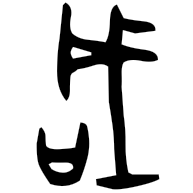 甲骨文 oracle bone · 商
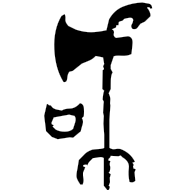 金文 bronze · 商代晚期
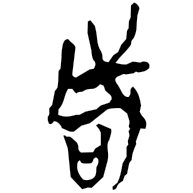 戰國文字 Warring States · 戰國.楚
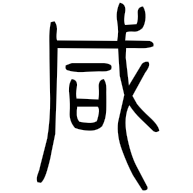 篆文 seal
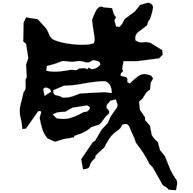 隸書 clerical · 秦
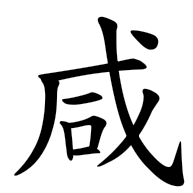 楷書 regular
Legge's note (1882)
Legge's title for the hexagram: mutual influence.
XXXI. With the 31st hexagram commences the Second Section of the Text. It is difficult to say why any division of the hexagrams should be made here, for the student tries in vain to discover any continuity in the thoughts of the author that is now broken. The First Section does not contain a class of subjects different from those which we find in the Second. That the division was made, however, at a very early time, appears from the sixth Appendix on the Sequence of the Hexagrams, where the writer sets forth an analogy between the first and second figures, representing heaven and earth, as the originators of all things, and this figure and the next, representing (each of them) husband and wife, as the originators of all the social relations. This, however, is far from carrying conviction to my mind. The division of the Text of the Yî into two sections is a fact of which I am unable to give a satisfactory account. Hsien, as explained in the treatise on the Thwan, has here the meaning of mutual influence, and the duke of Kâu, on the various lines, always uses Kan for it in the sense of ‘moving’ or ‘influencing to movement or action.’ This is to my mind the subject of the hexagram considered as an essay,—‘Influence; the different ways of bringing it to bear, and their issues.’ The Chinese character called hsien is ne the graphic symbol for ‘all, together, jointly.” Kan, the symbol for ‘influencing,’ has hsien in it as its phonetic constituent (though the changes in pronunciation make it hard for an English reader to appreciate this), with the addition of hsin, the symbol for ‘the heart.’ Thus le& kan, ‘to affect or influence,’ = Jay + i); and it may have been that while the name or word was used with the significance of ‘influencing,’ the,\Y\) was purposely dropt from it, to indicate the most important element in the thing,—the absence of all purpose or motive. I venture to think that this would have been a device worthy of a diviner. With regard to the idea of husband and wife being in the teaching of the hexagram, it is derived from the more recent symbolism of the eight trigrams ascribed to king Wăn, and exhibited on p. 33 and plate III. The more ancient usage of them is given in the paragraph on the Great Symbolism of Appendix II. The figure consists of Kăn, ‘the youngest son,’ and over it Tui, ‘the youngest daughter.’ These are in ‘happy union.’ No influence, it is said, is so powerful and constant as that between husband and wife; and where these are young, it is especially active. Hence it is that Hsien is made up of Kăn and Tui. All this is to me very doubtful. I can dimly apprehend why the whole line (———) was assumed as the symbol of strength and authority, and the broken line as that of weakness and submission. Beyond this I cannot follow Fû-hsî in his formation of the trigrams; and still less can I assent to the more recent symbolism of them ascribed to king Wăn. Coming now to the figure, and its lines, the subject is that of mutual influence; and the author teaches that that influence, correct in itself, and for correct ends, is sure to be effective. He gives an instance,—the case of a man marrying a young lady, the regulations for which have been laid down in China from the earliest times with great strictness and particularity. Such influence will be effective and fortunate. Line 1 is weak, and at the bottom of the hexagram. Though 4 be a proper correlate, yet the influence indicated by it must be ineffective. However much a man’s great toes may be moved, that will not enable him to walk. The calves cannot move of themselves. They follow the moving of the feet. The moving of them indicates too much anxiety to move. Line 2, moreover, is weak. But it is also the central line, and if its subject abide quiet, till he is acted on from above, there will be good fortune. Neither can the thighs move of themselves. The attempt to move them is inauspicious. Its subject, however, the line being strong, and in an odd place, will wish to move, and follows the subject of 4, which is understood to be the seat of the mind. He exercises his influence therefore with a mind and purpose, which is not good. Line 4 is strong, but in an even place. It is the seat of the mind. Its subject therefore is warned to be firm and correct in order to a good issue. If he be wavering and uncertain, his influence will not extend beyond the circle of his friends. The symbolism of line 5 refers to a part of the body behind the heart, and is supposed therefore to indicate an influence, ineffective indeed, but free from selfish motive, and not needing to be repented of. Line 6 is weak, and in an even place. It is the topmost line also of the trigram of satisfaction. Its influence by means of speech will only be that of loquacity and flattery, the evil of which needs not to be pointed out.
Sources
- Chinese text: 周易, 維基文庫, page (revision 10646450); the text is public domain, the site's edits CC BY-SA 4.0.
- English: James Legge, The Yî King, Sacred Books of the East vol. XVI, Oxford 1882 (public domain), where this hexagram is “Hsien”.
- Glyph images: 小學堂 字形演變, Academia Sinica (CC0 1.0).
- Pinyin: Unihan (Unicode License v3) with this site's readings for the classical cases. English gloss, relations, the idiom glosses, the English of the chronicle passages and the plain reading: this site.